


Page 345 - Reservoir Formation Damage
P. 345
Inorganic Scaling and Geochemical Formation Damage  325

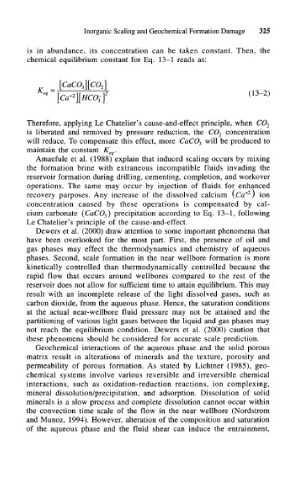
             is  in  abundance,  its  concentration  can  be  taken  constant.  Then,  the
             chemical  equilibrium  constant  for  Eq.  13-1  reads  as:


                      [CaC0 3][CQ 2]
                   =
                                                                        (13-2)


             Therefore,  applying Le  Chatelier's  cause-and-effect principle,  when  CO 2
             is  liberated  and  removed  by  pressure  reduction,  the  CO 2  concentration
             will  reduce. To compensate  this  effect,  more  CaCO 3  will  be  produced  to
             maintain  the  constant  K eq.
               Amaefule  et  al.  (1988)  explain  that  induced  scaling  occurs  by mixing
             the  formation  brine  with  extraneous  incompatible  fluids  invading  the
             reservoir  formation during drilling, cementing, completion,  and  workover
             operations.  The  same  may  occur  by  injection  of  fluids  for  enhanced
                                                                       +2
             recovery  purposes.  Any  increase  of  the  dissolved  calcium  \Ca )  ion
             concentration  caused  by  these  operations  is  compensated  by  cal-
             cium  carbonate  (CaCO 3)  precipitation  according  to  Eq.  13-1, following
             Le Chatelier's  principle  of  the  cause-and-effect.
               Dewers  et  al.  (2000)  draw  attention  to  some  important phenomena  that
             have  been  overlooked  for  the  most  part.  First,  the  presence  of  oil  and
             gas  phases  may  effect  the  thermodynamics  and  chemistry  of  aqueous
             phases.  Second,  scale  formation  in  the  near  wellbore  formation  is  more
             kinetically  controlled  than  thermodynamically  controlled  because  the
             rapid  flow  that  occurs  around  wellbores  compared  to  the  rest  of  the
             reservoir  does  not  allow  for  sufficient  time to attain equilibrium. This  may
             result  with  an  incomplete  release  of  the  light  dissolved  gases,  such  as
             carbon  dioxide,  from  the  aqueous  phase.  Hence,  the  saturation  conditions
             at  the  actual  near-wellbore  fluid  pressure  may  not  be  attained  and  the
             partitioning  of various light  gases  between  the  liquid  and  gas phases  may
             not  reach  the  equilibrium  condition.  Dewers  et  al.  (2000)  caution  that
             these  phenomena  should  be  considered  for  accurate  scale  prediction.
               Geochemical  interactions  of  the  aqueous  phase  and  the  solid  porous
             matrix  result  in  alterations  of  minerals  and  the  texture,  porosity  and
             permeability  of  porous  formation.  As  stated  by  Lichtner  (1985),  geo-
             chemical  systems  involve  various  reversible  and  irreversible  chemical
             interactions,  such  as  oxidation-reduction  reactions,  ion  complexing,
             mineral  dissolution/precipitation,  and  adsorption.  Dissolution  of  solid
             minerals  is  a  slow  process  and  complete  dissolution  cannot  occur within
             the  convection  time  scale  of  the  flow  in  the  near  wellbore  (Nordstrom
             and  Munoz,  1994).  However,  alteration  of  the  composition  and saturation
             of  the  aqueous  phase  and  the  fluid  shear  can  induce  the  entrainment,

