


Page 299 - Reservoir Geomechanics
P. 299
277    Stress fields


                   55                      Normal faulting


                   50    S v


                   45
                                                            1982
                   40

                                                   DEPLETION
                  Stress (MPa)  35               1990


                   30
                                       1998

                   25
                          = 0.6
                   20


                   15


                   10
                      10   15   20    25   30    35   40    45   50    55
                                         Pore pressure (MPa)


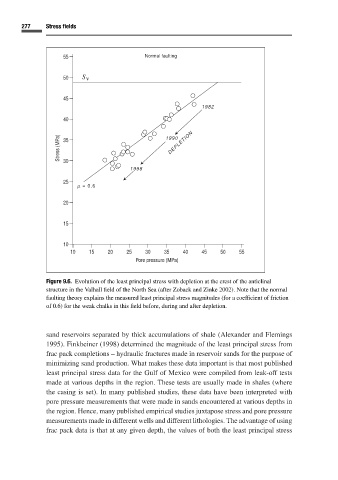
               Figure 9.6. Evolution of the least principal stress with depletion at the crest of the anticlinal
               structure in the Valhall field of the North Sea (after Zoback and Zinke 2002). Note that the normal
               faulting theory explains the measured least principal stress magnitudes (for a coefficient of friction
               of 0.6) for the weak chalks in this field before, during and after depletion.


               sand reservoirs separated by thick accumulations of shale (Alexander and Flemings
               1995). Finkbeiner (1998) determined the magnitude of the least principal stress from
               frac pack completions – hydraulic fractures made in reservoir sands for the purpose of
               minimizing sand production. What makes these data important is that most published
               least principal stress data for the Gulf of Mexico were compiled from leak-off tests
               made at various depths in the region. These tests are usually made in shales (where
               the casing is set). In many published studies, these data have been interpreted with
               pore pressure measurements that were made in sands encountered at various depths in
               the region. Hence, many published empirical studies juxtapose stress and pore pressure
               measurements made in different wells and different lithologies. The advantage of using
               frac pack data is that at any given depth, the values of both the least principal stress

