


Page 461 - Robot Builder's Bonanza
P. 461
430    AN OVERVIEW OF ROBOT “BRAINS”


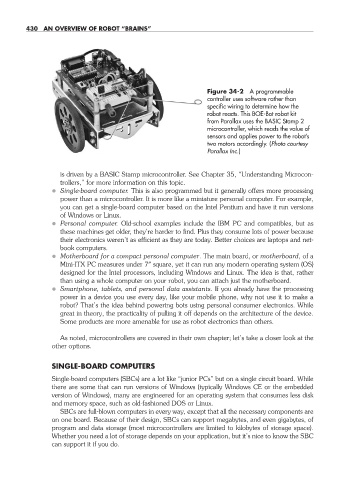
                                                              Figure 34- 2  A programmable
                                                              controller uses software rather than
                                                              specific wiring to determine how the
                                                              robot reacts. This  BOE- Bot robot kit
                                                              from Parallax uses the BASIC Stamp 2
                                                              microcontroller, which reads the value of
                                                              sensors and applies power to the robot’s
                                                              two motors accordingly. (Photo courtesy
                                                              Parallax Inc.)


                     is  driven by a BASIC Stamp microcontroller. See Chapter 35, “Understanding Microcon-
                     trollers,” for more information on this topic.
                   •     Single- board computer. This is also programmed but it generally offers more processing
                     power than a microcontroller. It is more like a miniature personal computer. For example,
                     you can get a  single- board computer based on the Intel Pentium and have it run versions
                     of Windows or Linux.
                   •   Personal computer.  Old- school examples include the IBM PC and compatibles, but as
                     these machines get older, they’re harder to find. Plus they consume lots of power because
                     their electronics weren’t as efficient as they are today. Better choices are laptops and net-
                     book computers.
                   •   Motherboard for a compact personal computer. The main board, or motherboard, of a
                       Mini- ITX PC measures under 7″ square, yet it can run any modern operating system (OS)
                     designed for the Intel processors, including Windows and Linux. The idea is that, rather
                     than using a whole computer on your robot, you can attach just the motherboard.
                   •   Smartphone, tablets, and personal data assistants. If you already have the processing
                     power in a device you use every day, like your mobile phone, why not use it to make a
                     robot? That’s the idea behind powering bots using personal consumer electronics. While
                     great in theory, the practicality of pulling it off depends on the architecture of the device.
                     Some products are more amenable for use as robot electronics than others.
                     As noted, microcontrollers are covered in their own chapter; let’s take a closer look at the
                   other options.

                     SINGLE- BOARD COMPUTERS

                     Single- board computers (SBCs) are a lot like “junior PCs” but on a single circuit board. While
                   there are some that can run versions of Windows (typically Windows CE or the embedded
                   version of Windows), many are engineered for an operating system that consumes less disk
                   and memory space, such as  old- fashioned DOS or Linux.
                     SBCs are  full- blown computers in every way, except that all the necessary components are
                   on one board. Because of their design, SBCs can support megabytes, and even gigabytes, of
                   program and data storage (most microcontrollers are limited to kilobytes of storage space).
                   Whether you need a lot of storage depends on your application, but it’s nice to know the SBC
                   can support it if you do.


   34-chapter-34.indd   430                                                                     4/21/11   11:57 AM

