


Page 463 - Robot Builder's Bonanza
P. 463
432    AN OVERVIEW OF ROBOT “BRAINS”


                     A netbook is an even smaller lightweight alternative. Many run a version of Windows or
                   else a proprietary operating system. Be careful with netbooks with a proprietary OS, as you
                   may not be able to write programs for use with your robot. Like laptop PCs, netbooks are
                   battery powered.

                     Mini- ITX PC
                   And yet another option is the  Mini- ITX PC, so called because it uses a  mini- ITX motherboard.
                     Mini- ITX is not a brand but technically a “form factor” and design architecture. The board
                   measures 6.7″   6.7″, and many versions don’t need a fan for cooling.
                   If using a  Mini- ITX PC in a case designed for AC operation, you can still give it power on your
                   mobile robot by using a 12- volt battery and car power inverter. The inverter takes the 12 volts
           G       DC from the battery and generates 110 volts AC for the computer.
                     While this sounds like a roundabout way to go, it’s not quite as inefficient as it seems. Still,
                   you need a strong battery to power the computer for any length of time. A 12- volt motorcycle
                   battery is one option.
                     Mini- ITX Motherboard
                   While plopping a whole  Mini- ITX PC on top of your robot is a quick and convenient way to
                   endow it with smarts, the case and power supply add unnecessary weight that reduce battery
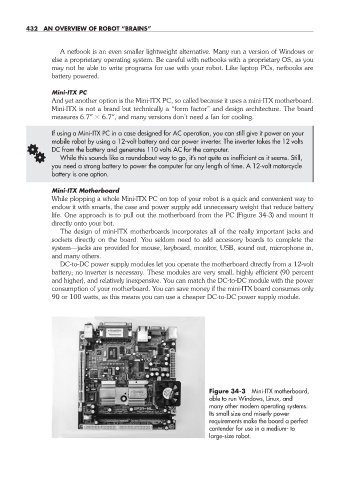
                   life. One approach is to pull out the motherboard from the PC (Figure 34- 3) and mount it
                   directly onto your bot.
                     The design of  mini- ITX motherboards incorporates all of the  really important jacks and
                   sockets directly on the board. You seldom need to add accessory boards to complete the
                     system— jacks are provided for mouse, keyboard, monitor, USB, sound out, microphone in,
                   and many others.
                     DC- to- DC power supply modules let you operate the motherboard directly from a 12- volt
                   battery; no inverter is necessary. These modules are very small, highly efficient (90 percent
                   and higher), and relatively inexpensive. You can match the  DC- to- DC module with the power
                   consumption of your motherboard. You can save money if the  mini- ITX board consumes only
                   90 or 100 watts, as this means you can use a cheaper  DC- to- DC power supply module.


                                                               Figure 34- 3   Mini- ITX motherboard,
                                                               able to run Windows, Linux, and
                                                               many other modern operating systems.
                                                               Its small size and miserly power
                                                               requirements make the board a perfect
                                                               contender for use in a medium-  to
                                                                 large- size robot.


   34-chapter-34.indd   432                                                                     4/21/11   11:57 AM

