


Page 102 - Robot Builders Source Book - Gordon McComb
P. 102
3.5 Pneumodrive                             91

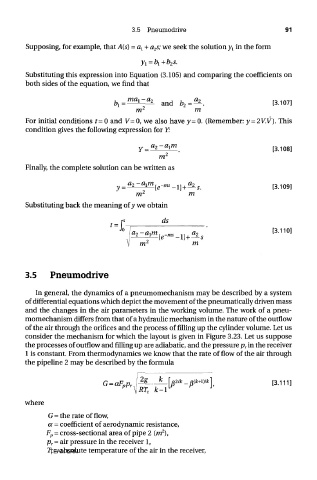
        Supposing, for example, that A(s) = a^ + a 2s; we seek the solution y l in the form


        Substituting this expression into Equation (3.105) and comparing the coefficients on
        both sides of the equation, we find that


                                        in               in,
        For initial conditions t= 0 and V= 0, we also have y= 0. (Remember: y = 2V.V}. This
        condition gives the following expression for Y:


        Finally, the complete solution can be written as


        Substituting back the meaning of y we obtain


        3.5    Pneumodrive

           In general, the dynamics of a pneumomechanism may be described by a system
        of differential equations which depict the movement of the pneumatically driven mass
        and the changes in the air parameters in the working volume. The work of a pneu-
        momechanism differs from that of a hydraulic mechanism in the nature of the outflow
        of the air through the orifices and the process of filling up the cylinder volume. Let us
        consider the mechanism for which the layout is given in Figure 3.23. Let us suppose
        the processes of outflow and filling up are adiabatic, and the pressure p r in the receiver
        1 is constant. From thermodynamics we know that the rate of flow of the air through
        the pipeline 2 may be described by the formula


        where
               G = the rate of flow,
               a = coefficient of aerodynamic resistance,
                                               2
              F p = cross-sectional area of pipe 2 (m ),
              p r = air pressure in the receiver 1,
              T r = absolute temperature of the air in the receiver,
               TEAM LRN

