


Page 107 - Robot Builders Source Book - Gordon McComb
P. 107
96                         Dynamic Analysis of Drives

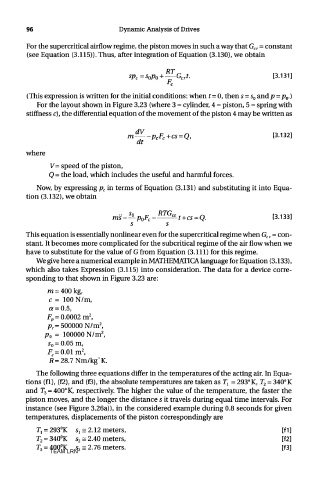
        For the supercritical airflow regime, the piston moves in such a way that G cr = constant
         (see Equation (3.115)). Thus, after integration of Equation (3.130), we obtain


         (This expression is written for the initial conditions: when t = 0, then s = S Q and p = p Q.)
           For the layout shown in Figure 3.23 (where 3 = cylinder, 4 = piston, 5 = spring with
        stiffness c), the differential equation of the movement of the piston 4 may be written as


        where
               V= speed of the piston,
               Q = the load, which includes the useful and harmful forces.
           Now, by expressing p c in terms of Equation (3.131) and substituting it into Equa-
        tion (3.132), we obtain


        This equation is essentially nonlinear even for the supercritical regime when G c r = con-
        stant. It becomes more complicated for the subcritical regime of the air flow when we
        have to substitute for the value of G from Equation (3.111) for this regime.
           We give here a numerical example in MATHEMATICA language for Equation (3.133),
        which also takes Expression (3.115) into consideration. The data for a device corre-
        sponding to that shown in Figure 3.23 are:
               m = 400 kg,
               c = 100 N/m,
               a = 0.5,
                          2
              F p = 0.0002m ,
                             2
               p r = 500000 N/m ,
                              2
              p Q = 100000 N/m ,
               S 0 = 0.05 m,
                        2
               F c = 0.01m ,
               # = 28.7Nm/kg°K.
           The following three equations differ in the temperatures of the acting air. In Equa-
        tions (fl), (£2), and (f3), the absolute temperatures are taken as T r = 293° K, T 2 = 340° K
        and T 3 = 400° K, respectively. The higher the value of the temperature, the faster the
        piston moves, and the longer the distance 5 it travels during equal time intervals. For
        instance (see Figure 3.26a)), in the considered example during 0.8 seconds for given
        temperatures, displacements of the piston correspondingly are

           T! = 293°K ^ = 2.12 meters,                                            [f 1 ]
           T 2 = 340°K s 2 = 2.40 meters,                                        [f2]
           T 3 = 400°K s 3 = 2.76 meters.                                         [f3]
               TEAM LRN

