


Page 111 - Robot Builders Source Book - Gordon McComb
P. 111
100                        Dynamic Analysis of Drives

        the shortest possible time followed by locking of the drive as soon as the moving
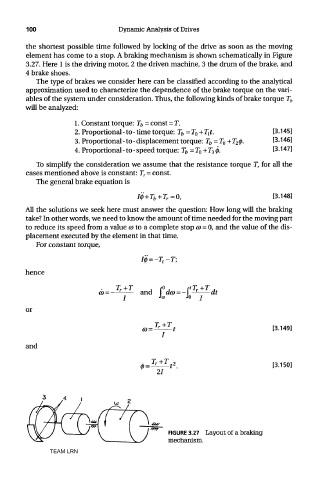
        element has come to a stop. A braking mechanism is shown schematically in Figure
        3.27. Here 1 is the driving motor, 2 the driven machine, 3 the drum of the brake, and
        4 brake shoes.
           The type of brakes we consider here can be classified according to the analytical
        approximation used to characterize the dependence of the brake torque on the vari-
        ables of the system under consideration. Thus, the following kinds of brake torque T b
        will be analyzed:


           To simplify the consideration we assume that the resistance torque T T for all the
        cases mentioned above is constant: T r = const.
           The general brake equation is


        All the solutions we seek here must answer the question: How long will the braking
        take? In other words, we need to know the amount of time needed for the moving part
        to reduce its speed from a value CD to a complete stop CD = 0, and the value of the dis-
        placement executed by the element in that time.
           For constant torque,


        hence


        or


        and


                                                 FIGURE 3.27 Layout of a braking
                                                 mechanism.
               TEAM LRN

