


Page 114 - Robot Builders Source Book - Gordon McComb
P. 114
3.7 Drive with a Variable Moment of Inertia           103

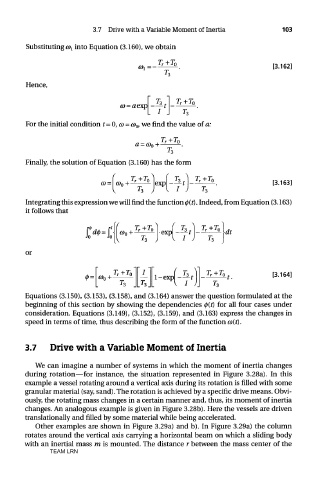
        Substituting «! into Equation (3.160), we obtain


        Hence,


        For the initial condition t= 0, CD = CO Q, we find the value of a:


        Finally, the solution of Equation (3.160) has the form


        Integrating this expression we will find the function 0(£). Indeed, from Equation (3.163
        it follows that


        or


        Equations (3.150), (3.153), (3.158), and (3.164) answer the question formulated at the
        beginning of this section by showing the dependencies <j)(f) for all four cases under
        consideration. Equations (3.149), (3.152), (3.159), and (3.163) express the changes in
        speed in terms of time, thus describing the form of the function (o(t).


        3.7    Drive with a Variable Moment of Inertia

           We can imagine a number of systems in which the moment of inertia changes
        during rotation—for instance, the situation represented in Figure 3.28a). In this
        example a vessel rotating around a vertical axis during its rotation is filled with some
        granular material (say, sand). The rotation is achieved by a specific drive means. Obvi-
        ously, the rotating mass changes in a certain manner and, thus, its moment of inertia
        changes. An analogous example is given in Figure 3.28b). Here the vessels are driven
        translationally and filled by some material while being accelerated.
           Other examples are shown in Figure 3.29a) and b). In Figure 3.29a) the column
        rotates around the vertical axis carrying a horizontal beam on which a sliding body
        with an inertial mass m is mounted. The distance r between the mass center of the
               TEAM LRN

