


Page 26 - Robot Builders Source Book - Gordon McComb
P. 26
1.3 Manipulators                            15

         principle, any point inside the sphere can be reached by a gripper fixed to the end of
         an arm. In reality, there are certain restrictions imposed by the real dimensions of the
         links and the restraints of the joints which result in a dead zone in the middle of the
         sphere. Sometimes the angle of rotation </> is also restricted (possibly because, for
        instance, of the twisting of pipes or cables providing energy and a means of control to
         the links).
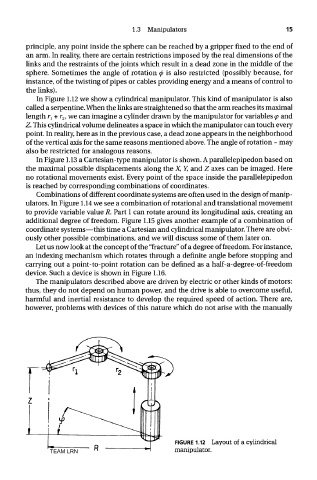
           In Figure 1.12 we show a cylindrical manipulator. This kind of manipulator is also
         called a serpentine. When the links are straightened so that the arm reaches its maximal
        length r l + r 2, we can imagine a cylinder drawn by the manipulator for variables <p and
        Z. This cylindrical volume delineates a space in which the manipulator can touch every
        point. In reality, here as in the previous case, a dead zone appears in the neighborhood
         of the vertical axis for the same reasons mentioned above. The angle of rotation ~ may
         also be restricted for analogous reasons.
           In Figure 1.13 a Cartesian-type manipulator is shown. A parallelepipedon based on
        the maximal possible displacements along the X, Y, and Z axes can be imaged. Here
         no rotational movements exist. Every point of the space inside the parallelepipedon
         is reached by corresponding combinations of coordinates.
           Combinations of different coordinate systems are often used in the design of manip-
        ulators. In Figure 1.14 we see a combination of rotational and translational movement
        to provide variable value R. Part 1 can rotate around its longitudinal axis, creating an
         additional degree of freedom. Figure 1.15 gives another example of a combination of
         coordinate systems—this time a Cartesian and cylindrical manipulator. There are obvi-
         ously other possible combinations, and we will discuss some of them later on.
           Let us now look at the concept of the "fracture" of a degree of freedom. For instance,
        an indexing mechanism which rotates through a definite angle before stopping and
        carrying out a point-to-point rotation can be denned as a half-a-degree-of-freedom
        device. Such a device is shown in Figure 1.16.
           The manipulators described above are driven by electric or other kinds of motors:
        thus, they do not depend on human power, and the drive is able to overcome useful,
        harmful and inertial resistance to develop the required speed of action. There are,
        however, problems with devices of this nature which do not arise with the manually


                                                    FIGURE 1.12 Layout of a cylindrical
               TEAM LRN                             manipulator.

