


Page 101 - Robotics Designing the Mechanisms for Automated Machinery
P. 101
90                        Dynamic Analysis of Drives

         Integrating this, latter expression we obtain the required formula in the following form:


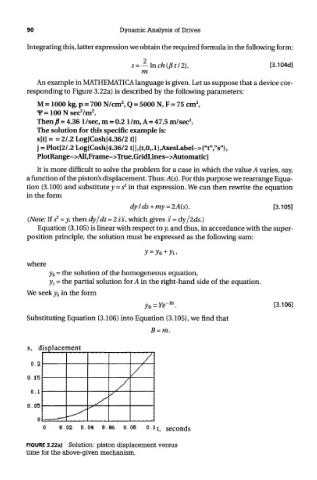
           An example in MATHEMATICA language is given. Let us suppose that a device cor-
         responding to Figure 3.22a) is described by the following parameters:
                                                         2
                                    2
            M = 1000 kg, p = 700 N/cm , Q = 5000 N, F = 75 cm ,
                       2   2
            ¥=100Nsec /m .
                                                       2
            Then ft = 4.36 I/sec, m = 0.2 1/m, A = 47.5 ml sec .
           The solution for this specific example is:
            s[t] = = 2/.2 Log[Cosh[4.36/2 t]l
           j = Plot[2/.2 Log[Cosh[4.36/2 t]],{t,0,.l},AxesLabel->{"t","s"},
            PlotRange->AU,Frame->True,GridLines->Automaticl
            It is more difficult to solve the problem for a case in which the value A varies, say,
         a function of the piston's displacement. Thus: A(s). For this purpose we rearrange Equa-
                                     2
        tion (3.100) and substitute y = s  in that expression. We can then rewrite the equation
        in the form

                 2
         (Note: If s  = y, then dy/dt=2ss, which gives s = dy/2ds.}
           Equation (3.105) is linear with respect to y, and thus, in accordance with the super-
        position principle, the solution must be expressed as the following sum:


        where
               y 0 = the solution of the homogeneous equation,
               y l = the partial solution for A in the right-hand side of the equation.
        We seek y 0 in the form


        Substituting Equation (3.106) into Equation (3.105), we find that


        FIGURE 3.22a) Solution: piston displacement versus
        time for the above-given mechanism.

