


Page 99 - Robotics Designing the Mechanisms for Automated Machinery
P. 99
88                         Dynamic Analysis of Drives

        Obviously, the calculations shown above answer the following questions:
           • How long does it take for the drive to reach the desired angle or (using corre-
              sponding transmission) displacement?
           • How long does it take for the drive to reach the desired speed?
           • What angle, displacement, or speed can be reached during a specific time interval?
           • Which parameters of the motor must be taken into account to reach the desired
              angle, displacement, or speed in a specific time?


        3.4 Hydraulic Drive

           Let us now learn how to estimate the displacement time of a mass driven by a hydro -
        mechanism.
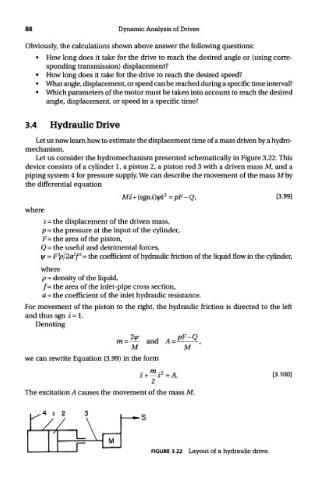
           Let us consider the hydromechanism presented schematically in Figure 3.22. This
        device consists of a cylinder 1, a piston 2, a piston rod 3 with a driven mass M, and a
        piping system 4 for pressure supply. We can describe the movement of the mass Mby
        the differential equation


        where
              5 = the displacement of the driven mass,
             p = the pressure at the input of the cylinder,
             F= the area of the piston,
             Q = the useful and detrimental forces,
                  3
                      2 2
             ^ = F p/2a f  = the coefficient of hydraulic friction of the liquid flow in the cylinder,
             where
             p = density of the liquid,
             /= the area of the inlet-pipe cross section,
             a = the coefficient of the inlet hydraulic resistance.

        For movement of the piston to the right, the hydraulic friction is directed to the left
        and thus sgn 5=1.
           Denoting


        we can rewrite Equation (3.99) in the form


        The excitation A causes the movement of the mass M.


                                            FIGURE 3.22 Layout of a hydraulic drive.

