


Page 79 - Robotics Designing the Mechanisms for Automated Machinery
P. 79
68                         Dynamic Analysis of Drives

           In a more realistic approach, we must consider a resisting force acting on the mass
        m during its motion, as shown in Figure 3.4b). Since the nature of the force can vary,
        so can its analytic description. For example, if it is caused by dry friction, the force may
        be described analytically in the form


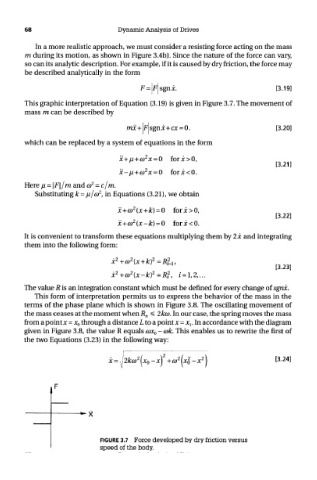
        This graphic interpretation of Equation (3.19) is given in Figure 3.7. The movement of
        mass m can be described by


        which can be replaced by a system of equations in the form


                           2
        Here // = \F\/m and co  = c/m.
                             2
           Substituting k = fj./co , in Equations (3.21), we obtain


        It is convenient to transform these equations multiplying them by 2 x and integrating
        them into the following form:


        The value R is an integration constant which must be defined for every change of sgnx.
           This form of interpretation permits us to express the behavior of the mass in the
        terms of the phase plane which is shown in Figure 3.8. The oscillating movement of
        the mass ceases at the moment when R n =£ 2kco. In our case, the spring moves the mass
        from a point x = x 0 through a distance L to a point x = x^ In accordance with the diagram
        given in Figure 3.8, the value R equals cox 0 - cok. This enables us to rewrite the first of
        the two Equations (3.23) in the following way:


                              FIGURE 3.7 Force developed by dry friction versus
                              speed of the body.

