


Page 160 - Sedimentology and Stratigraphy
P. 160
Soils and Palaeosols  147


                 are closely associated with the vertical water move-  . oxidising/reducing conditions (redox conditions),
                 ment as they involve the transfer of dissolved material  particularly with respect to iron minerals;
                 from one layer to another, the formation of new  . the development of layering (horizonation);
                 minerals and the breakdown of some original mineral  . the redistribution of clays, iron and organic mate-
                 material. The activity of plants is evident in most soils  rial into these different layers (illuviation);
                 by the presence of roots and the accumulation of  . the amount of organic matter that is preserved.
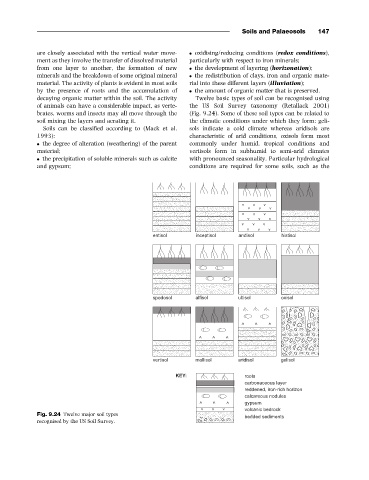
                 decaying organic matter within the soil. The activity  Twelve basic types of soil can be recognised using
                 of animals can have a considerable impact, as verte-  the US Soil Survey taxonomy (Retallack 2001)
                 brates, worms and insects may all move through the  (Fig. 9.24). Some of these soil types can be related to
                 soil mixing the layers and aerating it.      the climatic conditions under which they form: geli-
                   Soils can be classified according to (Mack et al.  sols indicate a cold climate whereas aridisols are
                 1993):                                       characteristic of arid conditions, oxisols form most
                 . the degree of alteration (weathering) of the parent  commonly under humid, tropical conditions and
                 material;                                    vertisols form in subhumid to semi-arid climates
                 . the precipitation of soluble minerals such as calcite  with pronounced seasonality. Particular hydrological
                 and gypsum;                                  conditions are required for some soils, such as the


             !


                                                                                      )        	      *


                 Fig. 9.24 Twelve major soil types
                 recognised by the US Soil Survey.

