


Page 158 - Sedimentology and Stratigraphy
P. 158
Alluvial Fans  145


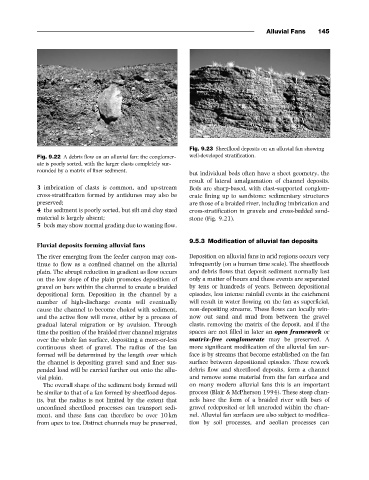
                                                              Fig. 9.23 Sheetflood deposits on an alluvial fan showing
                 Fig. 9.22 A debris flow on an alluvial fan: the conglomer-  well-developed stratification.
                 ate is poorly sorted, with the larger clasts completely sur-
                 rounded by a matrix of finer sediment.
                                                              but individual beds often have a sheet geometry, the
                                                              result of lateral amalgamation of channel deposits.
                 3 imbrication of clasts is common, and up-stream  Beds are sharp-based, with clast-supported conglom-
                 cross-stratification formed by antidunes may also be  erate fining up to sandstone: sedimentary structures
                 preserved;                                   are those of a braided river, including imbrication and
                 4 the sediment is poorly sorted, but silt and clay sized  cross-stratification in gravels and cross-bedded sand-
                 material is largely absent;                  stone (Fig. 9.21).
                 5 beds may show normal grading due to waning flow.

                                                              9.5.3 Modification of alluvial fan deposits
                 Fluvial deposits forming alluvial fans
                 The river emerging from the feeder canyon may con-  Deposition on alluvial fans in arid regions occurs very
                 tinue to flow as a confined channel on the alluvial  infrequently (on a human time scale). The sheetfloods
                 plain. The abrupt reduction in gradient as flow occurs  and debris flows that deposit sediment normally last
                 on the low slope of the plain promotes deposition of  only a matter of hours and these events are separated
                 gravel on bars within the channel to create a braided  by tens or hundreds of years. Between depositional
                 depositional form. Deposition in the channel by a  episodes, less intense rainfall events in the catchment
                 number of high-discharge events will eventually  will result in water flowing on the fan as superficial,
                 cause the channel to become choked with sediment,  non-depositing streams. These flows can locally win-
                 and the active flow will move, either by a process of  now out sand and mud from between the gravel
                 gradual lateral migration or by avulsion. Through  clasts, removing the matrix of the deposit, and if the
                 time the position of the braided river channel migrates  spaces are not filled in later an open framework or
                 over the whole fan surface, depositing a more-or-less  matrix-free conglomerate may be preserved. A
                 continuous sheet of gravel. The radius of the fan  more significant modification of the alluvial fan sur-
                 formed will be determined by the length over which  face is by streams that become established on the fan
                 the channel is depositing gravel: sand and finer sus-  surface between depositional episodes. These rework
                 pended load will be carried further out onto the allu-  debris flow and sheetflood deposits, form a channel
                 vial plain.                                  and remove some material from the fan surface and
                   The overall shape of the sediment body formed will  on many modern alluvial fans this is an important
                 be similar to that of a fan formed by sheetflood depos-  process (Blair & McPherson 1994). These steep chan-
                 its, but the radius is not limited by the extent that  nels have the form of a braided river with bars of
                 unconfined sheetflood processes can transport sedi-  gravel redeposited or left uneroded within the chan-
                 ment, and these fans can therefore be over 10 km  nel. Alluvial fan surfaces are also subject to modifica-
                 from apex to toe. Distinct channels may be preserved,  tion by soil processes, and aeolian processes can

