


Page 155 - Sedimentology and Stratigraphy
P. 155
142    Rivers and Alluvial Fans


                                                              relatively steep depositional surface and there is a
                                                              distinct break in slope at the fan toe, the limit of the
                                                              deposition of coarse detritus at the edge of the alluvial
                                                              fan. The fan deposits are thickest at the apex and
                                                              taper as a conical wedge towards the toe.


                  Fig. 9.18 Alluvial fans in the Death Valley, USA, a region
                  with a hot, arid climate.


                                                                              '((


                  Fig. 9.19 A colluvial fan, a mixture of scree and debris
                  flows in a cold, relatively dry setting in the Arctic.          ' '(


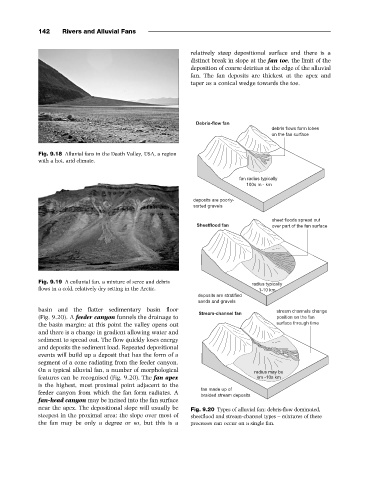
                  basin and the flatter sedimentary basin floor
                  (Fig. 9.20). A feeder canyon funnels the drainage to
                  the basin margin: at this point the valley opens out
                  and there is a change in gradient allowing water and
                  sediment to spread out. The flow quickly loses energy
                  and deposits the sediment load. Repeated depositional
                  events will build up a deposit that has the form of a
                  segment of a cone radiating from the feeder canyon.
                  On a typical alluvial fan, a number of morphological
                  features can be recognised (Fig. 9.20). The fan apex               '(
                  is the highest, most proximal point adjacent to the

                  feeder canyon from which the fan form radiates. A
                  fan-head canyon may be incised into the fan surface
                  near the apex. The depositional slope will usually be  Fig. 9.20 Types of alluvial fan: debris-flow dominated,
                  steepest in the proximal area: the slope over most of  sheetflood and stream-channel types – mixtures of these
                  the fan may be only a degree or so, but this is a  processes can occur on a single fan.

