


Page 153 - Sedimentology and Stratigraphy
P. 153
140    Rivers and Alluvial Fans


                  tendency for nearly all rivers (meandering and  and flows on the floodplain are faster and therefore
                  braided) to shift sideways through time by erosion of  more likely to erode.
                  one bank and deposition on the opposite side. Lateral  Rates of subsidence and the quantity of sediment
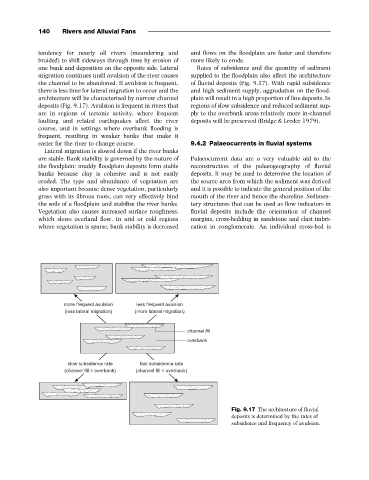
                  migration continues until avulsion of the river causes  supplied to the floodplain also affect the architecture
                  the channel to be abandoned. If avulsion is frequent,  of fluvial deposits (Fig. 9.17). With rapid subsidence
                  there is less time for lateral migration to occur and the  and high sediment supply, aggradation on the flood-
                  architecture will be characterised by narrow channel  plain will result in a high proportion of fine deposits. In
                  deposits (Fig. 9.17). Avulsion is frequent in rivers that  regions of slow subsidence and reduced sediment sup-
                  are in regions of tectonic activity, where frequent  ply to the overbank areas relatively more in-channel
                  faulting and related earthquakes affect the river  deposits will be preserved (Bridge & Leeder 1979).
                  course, and in settings where overbank flooding is
                  frequent, resulting in weaker banks that make it
                  easier for the river to change course.      9.4.2 Palaeocurrents in fluvial systems
                    Lateral migration is slowed down if the river banks
                  are stable. Bank stability is governed by the nature of  Palaeocurrent data are a very valuable aid to the
                  the floodplain: muddy floodplain deposits form stable  reconstruction of the palaeogeography of fluvial
                  banks because clay is cohesive and is not easily  deposits. It may be used to determine the location of
                  eroded. The type and abundance of vegetation are  the source area from which the sediment was derived
                  also important because dense vegetation, particularly  and it is possible to indicate the general position of the
                  grass with its fibrous roots, can very effectively bind  mouth of the river and hence the shoreline. Sedimen-
                  the soils of a floodplain and stabilise the river banks.  tary structures that can be used as flow indicators in
                  Vegetation also causes increased surface roughness,  fluvial deposits include the orientation of channel
                  which slows overland flow. In arid or cold regions  margins, cross-bedding in sandstone and clast imbri-
                  where vegetation is sparse, bank stability is decreased  cation in conglomerate. An individual cross-bed is


                                 "


               "
                         #

   $  #

   $


                         #	            %         $  #	            &         $


                                                                          Fig. 9.17 The architecture of fluvial
                                                                          deposits is determined by the rates of
                                                                          subsidence and frequency of avulsion.

