


Page 148 - Sedimentology and Stratigraphy
P. 148
River Forms   135


                                                              carried in shallower parts of the flow and is deposited
                                                              along the inner bend of a meander loop where friction

                           reduces the flow velocity. The deposits of a meander
                                                              bend have a characteristic profile of coarser material
                                                              at the base, becoming progressively finer-grained up
                                                              the inner bank (Fig. 9.11). The faster flow in the
                 Fig. 9.10 Flow in a river follows the sinuous thalweg  deeper parts of the channel forms subaqueous dunes
                 resulting in erosion of the bank in places.  in the sediment that develop trough or planar cross-
                                                              bedding as the sand accumulates. Higher up on the
                 while the opposite bank has slower flowing water  inner bank where the flow is slower, ripples form in
                 alongside. Meanders develop by the erosion of the  the finer sand, producing cross-lamination. A channel
                 bank closest to the thalweg, accompanied by deposi-  moving sideways by erosion on the outer bank and
                 tion on the opposite side of the channel where the  deposition on the inner bank is undergoing lateral
                 flow is sluggish and the bedload can no longer be  migration, and the deposit on the inner bank is
                 carried. With continued erosion of the outer bank  referred to as a point bar. A point bar deposit will
                 and deposition of bedload on the inner bank the  show a fining-up from coarser material at the base to
                 channel develops a bend and meander loops are  finer at the top (Fig. 9.13) and it may also show larger
                 formed (Figs 9.11 & 9.12). A distinction between  scale cross-bedding at the base and smaller sets of
                 river sinuosity and meandering form should be recog-  cross-lamination nearer to the top. As the channel
                 nised: a river is considered to be sinuous if the dis-  migrates the top of the point bar becomes the edge
                 tance measured along a stretch of channel divided by  of the floodplain and the fining-upward succession of
                 the direct distance between those points is greater  the point bar will be capped by overbank deposits.
                 than 1.5; a river is considered to be meandering if  Stages in the lateral migration of the point bar of
                 there is accumulation of sediment on the inside of  a meandering river can sometimes be recognised as
                 bends, as described below.                   inclined surfaces within the channel-fill succes-
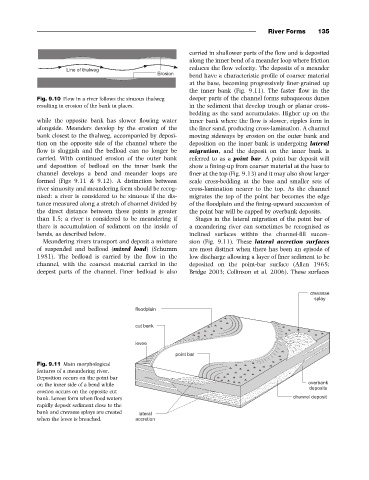
                   Meandering rivers transport and deposit a mixture  sion (Fig. 9.11). These lateral accretion surfaces
                 of suspended and bedload (mixed load) (Schumm  are most distinct when there has been an episode of
                 1981). The bedload is carried by the flow in the  low discharge allowing a layer of finer sediment to be
                 channel, with the coarsest material carried in the  deposited on the point-bar surface (Allen 1965;
                 deepest parts of the channel. Finer bedload is also  Bridge 2003; Collinson et al. 2006). These surfaces


                 Fig. 9.11 Main morphological
                 features of a meandering river.
                 Deposition occurs on the point bar

                 on the inner side of a bend while

                 erosion occurs on the opposite cut
                 bank. Levees form when flood waters
                 rapidly deposit sediment close to the
                 bank and crevasse splays are created
                 when the levee is breached.

