


Page 145 - Sedimentology and Stratigraphy
P. 145
132    Rivers and Alluvial Fans


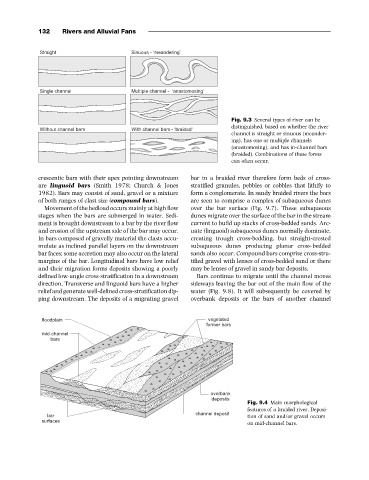
                                                                          Fig. 9.3 Several types of river can be


  	                         distinguished, based on whether the river
                                                                          channel is straight or sinuous (meander-
                                                                          ing), has one or multiple channels
                                                                          (anastomosing), and has in-channel bars
                                                                          (braided). Combinations of these forms
                                                                          can often occur.

                  crescentic bars with their apex pointing downstream  bar in a braided river therefore form beds of cross-
                  are linguoid bars (Smith 1978; Church & Jones  stratified granules, pebbles or cobbles that lithify to
                  1982). Bars may consist of sand, gravel or a mixture  form a conglomerate. In sandy braided rivers the bars
                  of both ranges of clast size (compound bars).  are seen to comprise a complex of subaqueous dunes
                    Movement of the bedload occurs mainly at high flow  over the bar surface (Fig. 9.7). These subaqueous
                  stages when the bars are submerged in water. Sedi-  dunes migrate over the surface of the bar in the stream
                  ment is brought downstream to a bar by the river flow  current to build up stacks of cross-bedded sands. Arc-
                  and erosion of the upstream side of the bar may occur.  uate (linguoid) subaqueous dunes normally dominate,
                  In bars composed of gravelly material the clasts accu-  creating trough cross-bedding, but straight-crested
                  mulate as inclined parallel layers on the downstream  subaqueous dunes producing planar cross-bedded
                  bar faces; some accretion may also occur on the lateral  sands also occur. Compound bars comprise cross-stra-
                  margins of the bar. Longitudinal bars have low relief  tified gravel with lenses of cross-bedded sand or there
                  and their migration forms deposits showing a poorly  may be lenses of gravel in sandy bar deposits.
                  defined low-angle cross-stratification in a downstream  Bars continue to migrate until the channel moves
                  direction. Transverse and linguoid bars have a higher  sideways leaving the bar out of the main flow of the
                  relief and generate well-defined cross-stratification dip-  water (Fig. 9.8). It will subsequently be covered by
                  ping downstream. The deposits of a migrating gravel  overbank deposits or the bars of another channel


                                                                               Fig. 9.4 Main morphological
                                                                               features of a braided river. Deposi-

  tion of sand and/or gravel occurs

                                                                               on mid-channel bars.

