


Page 149 - Sedimentology and Stratigraphy
P. 149
136    Rivers and Alluvial Fans


                                                               Meandering river

                                                                Scale  Lithology  MUD  SAND GRAVEL  Structures etc  Notes

                                                                         clay  silt  vf m vc  gran  pebb  cobb  boul
                                                                              c
                                                                            f
                                                                                            Overbank muds and
                                                                                            thin sands with soils
                                                                                            and roots


                                                               metres
                                                                                            Channel-fill
                                                                                            succession of
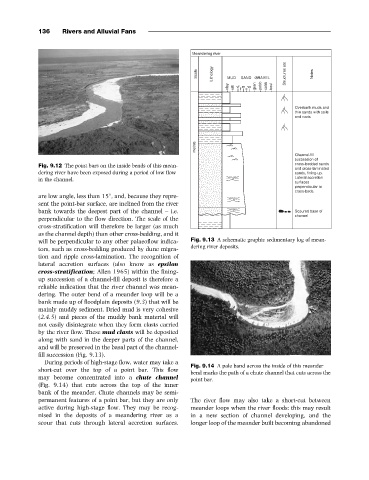
                  Fig. 9.12 The point bars on the inside bends of this mean-                cross-bedded sands
                                                                                            and cross-laminated
                  dering river have been exposed during a period of low flow                sands, fining-up.
                  in the channel.                                                           Lateral accretion
                                                                                            surfaces
                                                                                            perpendicular to
                                                                                            cross-beds.
                  are low angle, less than 158, and, because they repre-
                  sent the point-bar surface, are inclined from the river
                  bank towards the deepest part of the channel – i.e.                       Scoured base of
                                                                                            channel
                  perpendicular to the flow direction. The scale of the
                  cross-stratification will therefore be larger (as much
                  as the channel depth) than other cross-bedding, and it
                  will be perpendicular to any other palaeoflow indica-  Fig. 9.13 A schematic graphic sedimentary log of mean-
                  tors, such as cross-bedding produced by dune migra-  dering river deposits.
                  tion and ripple cross-lamination. The recognition of
                  lateral accretion surfaces (also know as epsilon
                  cross-stratification; Allen 1965) within the fining-
                  up succession of a channel-fill deposit is therefore a
                  reliable indication that the river channel was mean-
                  dering. The outer bend of a meander loop will be a
                  bank made up of floodplain deposits (9.3) that will be
                  mainly muddy sediment. Dried mud is very cohesive
                  (2.4.5) and pieces of the muddy bank material will
                  not easily disintegrate when they form clasts carried
                  by the river flow. These mud clasts will be deposited
                  along with sand in the deeper parts of the channel,
                  and will be preserved in the basal part of the channel-
                  fill succession (Fig. 9.13).
                    During periods of high-stage flow, water may take a
                                                              Fig. 9.14 A pale band across the inside of this meander
                  short-cut over the top of a point bar. This flow
                                                              bend marks the path of a chute channel that cuts across the
                  may become concentrated into a chute channel  point bar.
                  (Fig. 9.14) that cuts across the top of the inner
                  bank of the meander. Chute channels may be semi-
                  permanent features of a point bar, but they are only  The river flow may also take a short-cut between
                  active during high-stage flow. They may be recog-  meander loops when the river floods: this may result
                  nised in the deposits of a meandering river as a  in a new section of channel developing, and the
                  scour that cuts through lateral accretion surfaces.  longer loop of the meander built becoming abandoned

