


Page 144 - Sedimentology and Stratigraphy
P. 144
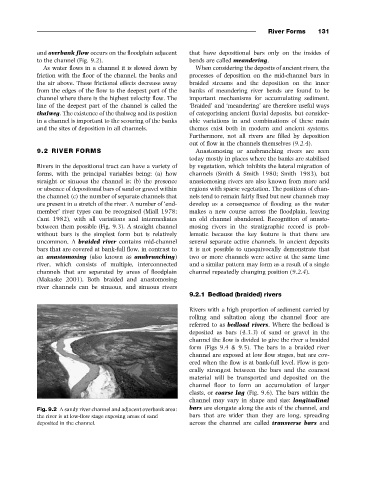
River Forms   131


                 and overbank flow occurs on the floodplain adjacent  that have depositional bars only on the insides of
                 to the channel (Fig. 9.2).                   bends are called meandering.
                   As water flows in a channel it is slowed down by  When considering the deposits of ancient rivers, the
                 friction with the floor of the channel, the banks and  processes of deposition on the mid-channel bars in
                 the air above. These frictional effects decrease away  braided streams and the deposition on the inner
                 from the edges of the flow to the deepest part of the  banks of meandering river bends are found to be
                 channel where there is the highest velocity flow. The  important mechanisms for accumulating sediment.
                 line of the deepest part of the channel is called the  ‘Braided’ and ‘meandering’ are therefore useful ways
                 thalweg. The existence of the thalweg and its position  of categorising ancient fluvial deposits, but consider-
                 in a channel is important to the scouring of the banks  able variations in and combinations of these main
                 and the sites of deposition in all channels.  themes exist both in modern and ancient systems.
                                                              Furthermore, not all rivers are filled by deposition
                                                              out of flow in the channels themselves (9.2.4).
                 9.2 RIVER FORMS                               Anastomosing or anabranching rivers are seen
                                                              today mostly in places where the banks are stabilised
                 Rivers in the depositional tract can have a variety of  by vegetation, which inhibits the lateral migration of
                 forms, with the principal variables being: (a) how  channels (Smith & Smith 1980; Smith 1983), but
                 straight or sinuous the channel is; (b) the presence  anastomosing rivers are also known from more arid
                 or absence of depositonal bars of sand or gravel within  regions with sparse vegetation. The positions of chan-
                 the channel; (c) the number of separate channels that  nels tend to remain fairly fixed but new channels may
                 are present in a stretch of the river. A number of ‘end-  develop as a consequence of flooding as the water
                 member’ river types can be recognised (Miall 1978;  makes a new course across the floodplain, leaving
                 Cant 1982), with all variations and intermediates  an old channel abandoned. Recognition of anasto-
                 between them possible (Fig. 9.3). A straight channel  mosing rivers in the stratigraphic record is prob-
                 without bars is the simplest form but is relatively  lematic because the key feature is that there are
                 uncommon. A braided river contains mid-channel  several separate active channels. In ancient deposits
                 bars that are covered at bank-full flow, in contrast to  it is not possible to unequivocally demonstrate that
                 an anastomosing (also known as anabranching)  two or more channels were active at the same time
                 river, which consists of multiple, interconnected  and a similar pattern may form as a result of a single
                 channels that are separated by areas of floodplain  channel repeatedly changing position (9.2.4).
                 (Makaske 2001). Both braided and anastomosing
                 river channels can be sinuous, and sinuous rivers
                                                              9.2.1 Bedload (braided) rivers

                                                              Rivers with a high proportion of sediment carried by
                                                              rolling and saltation along the channel floor are
                                                              referred to as bedload rivers. Where the bedload is
                                                              deposited as bars (4.3.3) of sand or gravel in the
                                                              channel the flow is divided to give the river a braided
                                                              form (Figs 9.4 & 9.5). The bars in a braided river
                                                              channel are exposed at low flow stages, but are cov-
                                                              ered when the flow is at bank-full level. Flow is gen-
                                                              erally strongest between the bars and the coarsest
                                                              material will be transported and deposited on the
                                                              channel floor to form an accumulation of larger
                                                              clasts, or coarse lag (Fig. 9.6). The bars within the
                                                              channel may vary in shape and size: longitudinal
                 Fig. 9.2 A sandy river channel and adjacent overbank area:  bars are elongate along the axis of the channel, and
                 the river is at low-flow stage exposing areas of sand  bars that are wider than they are long, spreading
                 deposited in the channel.                    across the channel are called transverse bars and

