


Page 143 - Sedimentology and Stratigraphy
P. 143
130    Rivers and Alluvial Fans


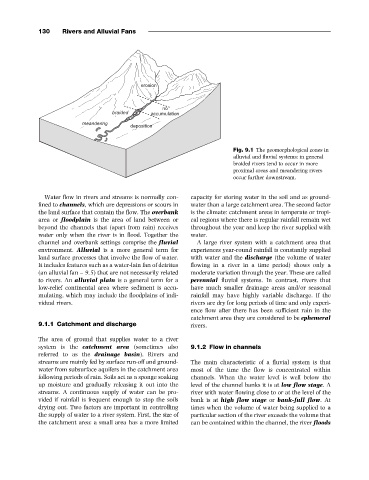
                                                                          Fig. 9.1 The geomorphological zones in
                                                                          alluvial and fluvial systems: in general
                                                                          braided rivers tend to occur in more
                                                                          proximal areas and meandering rivers
                                                                          occur further downstream.


                    Water flow in rivers and streams is normally con-  capacity for storing water in the soil and as ground-
                  fined to channels, which are depressions or scours in  water than a large catchment area. The second factor
                  the land surface that contain the flow. The overbank  is the climate: catchment areas in temperate or tropi-
                  area or floodplain is the area of land between or  cal regions where there is regular rainfall remain wet
                  beyond the channels that (apart from rain) receives  throughout the year and keep the river supplied with
                  water only when the river is in flood. Together the  water.
                  channel and overbank settings comprise the fluvial  A large river system with a catchment area that
                  environment. Alluvial is a more general term for  experiences year-round rainfall is constantly supplied
                  land surface processes that involve the flow of water.  with water and the discharge (the volume of water
                  It includes features such as a water-lain fan of detritus  flowing in a river in a time period) shows only a
                  (an alluvial fan – 9.5) that are not necessarily related  moderate variation through the year. These are called
                  to rivers. An alluvial plain is a general term for a  perennial fluvial systems. In contrast, rivers that
                  low-relief continental area where sediment is accu-  have much smaller drainage areas and/or seasonal
                  mulating, which may include the floodplains of indi-  rainfall may have highly variable discharge. If the
                  vidual rivers.                              rivers are dry for long periods of time and only experi-
                                                              ence flow after there has been sufficient rain in the
                                                              catchment area they are considered to be ephemeral
                  9.1.1 Catchment and discharge               rivers.

                  The area of ground that supplies water to a river
                  system is the catchment area (sometimes also  9.1.2 Flow in channels
                  referred to as the drainage basin). Rivers and
                  streams are mainly fed by surface run-off and ground-  The main characteristic of a fluvial system is that
                  water from subsurface aquifers in the catchment area  most of the time the flow is concentrated within
                  following periods of rain. Soils act as a sponge soaking  channels. When the water level is well below the
                  up moisture and gradually releasing it out into the  level of the channel banks it is at low flow stage.A
                  streams. A continuous supply of water can be pro-  river with water flowing close to or at the level of the
                  vided if rainfall is frequent enough to stop the soils  bank is at high flow stage or bank-full flow.At
                  drying out. Two factors are important in controlling  times when the volume of water being supplied to a
                  the supply of water to a river system. First, the size of  particular section of the river exceeds the volume that
                  the catchment area: a small area has a more limited  can be contained within the channel, the river floods

