


Page 138 - Sedimentology and Stratigraphy
P. 138
Desert Environments    125


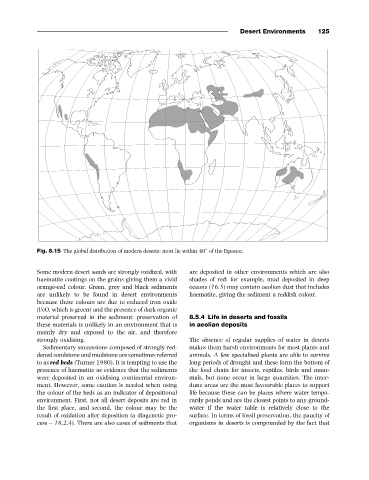
                 Fig. 8.15 The global distribution of modern deserts: most lie within 408 of the Equator.

                 Some modern desert sands are strongly oxidized, with  are deposited in other environments which are also
                 haematite coatings on the grains giving them a vivid  shades of red: for example, mud deposited in deep
                 orange-red colour. Green, grey and black sediments  oceans (16.5) may contain aeolian dust that includes
                 are unlikely to be found in desert environments  haematite, giving the sediment a reddish colour.
                 because these colours are due to reduced iron oxide
                 (FeO, which is green) and the presence of dark organic
                 material preserved in the sediment: preservation of  8.5.4 Life in deserts and fossils
                 these materials is unlikely in an environment that is  in aeolian deposits
                 mainly dry and exposed to the air, and therefore
                 strongly oxidising.                          The absence of regular supplies of water in deserts
                   Sedimentary successions composed of strongly red-  makes them harsh environments for most plants and
                 dened sandstone and mudstone are sometimes referred  animals. A few specialised plants are able to survive
                 to as red beds (Turner 1980). It is tempting to use the  long periods of drought and these form the bottom of
                 presence of haematite as evidence that the sediments  the food chain for insects, reptiles, birds and mam-
                 were deposited in an oxidising continental environ-  mals, but none occur in large quantities. The inter-
                 ment. However, some caution is needed when using  dune areas are the most favourable places to support
                 the colour of the beds as an indicator of depositional  life because these can be places where water tempo-
                 environment. First, not all desert deposits are red in  rarily ponds and are the closest points to any ground-
                 the first place, and second, the colour may be the  water if the water table is relatively close to the
                 result of oxidation after deposition (a diagenetic pro-  surface. In terms of fossil preservation, the paucity of
                 cess – 18.2.4). There are also cases of sediments that  organisms in deserts is compounded by the fact that

