


Page 139 - Sedimentology and Stratigraphy
P. 139
126    Aeolian Environments


    	     )
                    	                   %%


*

   %%


                                 )


   %%

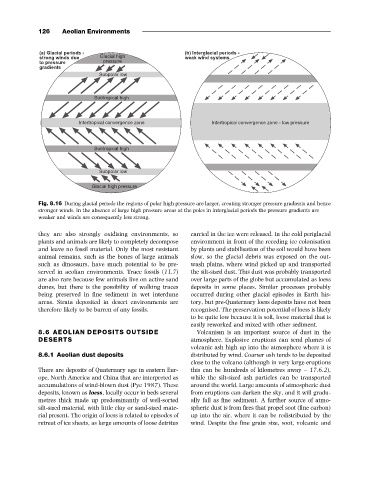
                  Fig. 8.16 During glacial periods the regions of polar high pressure are larger, creating stronger pressure gradients and hence
                  stronger winds. In the absence of large high pressure areas at the poles in interglacial periods the pressure gradients are
                  weaker and winds are consequently less strong.
                  they are also strongly oxidising environments, so  carried in the ice were released. In the cold periglacial
                  plants and animals are likely to completely decompose  environment in front of the receding ice colonisation
                  and leave no fossil material. Only the most resistant  by plants and stabilisation of the soil would have been
                  animal remains, such as the bones of large animals  slow, so the glacial debris was exposed on the out-
                  such as dinosaurs, have much potential to be pre-  wash plains, where wind picked up and transported
                  served in aeolian environments. Trace fossils (11.7)  the silt-sized dust. This dust was probably transported
                  are also rare because few animals live on active sand  over large parts of the globe but accumulated as loess
                  dunes, but there is the possibility of walking traces  deposits in some places. Similar processes probably
                  being preserved in fine sediment in wet interdune  occurred during other glacial episodes in Earth his-
                  areas. Strata deposited in desert environments are  tory, but pre-Quaternary loess deposits have not been
                  therefore likely to be barren of any fossils.  recognised. The preservation potential of loess is likely
                                                              to be quite low because it is soft, loose material that is
                                                              easily reworked and mixed with other sediment.
                  8.6 AEOLIAN DEPOSITS OUTSIDE                  Volcanism is an important source of dust in the
                  DESERTS                                     atmosphere. Explosive eruptions can send plumes of
                                                              volcanic ash high up into the atmosphere where it is
                  8.6.1 Aeolian dust deposits                 distributed by wind. Coarser ash tends to be deposited
                                                              close to the volcano (although in very large eruptions
                  There are deposits of Quaternary age in eastern Eur-  this can be hundreds of kilometres away – 17.6.2),
                  ope, North America and China that are interpreted as  while the silt-sized ash particles can be transported
                  accumulations of wind-blown dust (Pye 1987). These  around the world. Large amounts of atmospheric dust
                  deposits, known as loess, locally occur in beds several  from eruptions can darken the sky, and it will gradu-
                  metres thick made up predominantly of well-sorted  ally fall as fine sediment. A further source of atmo-
                  silt-sized material, with little clay or sand-sized mate-  spheric dust is from fires that propel soot (fine carbon)
                  rial present. The origin of loess is related to episodes of  up into the air, where it can be redistributed by the
                  retreat of ice sheets, as large amounts of loose detritus  wind. Despite the fine grain size, soot, volcanic and

