


Page 136 - Sedimentology and Stratigraphy
P. 136
Desert Environments    123


                  Arid zone                                   between sea level and sediment accumulation in
                                                              other environments is considered in Chapter 23.
                   Scale  Lithology  MUD  SAND  GRAVEL  Structures etc  Notes
                            clay  silt  vf m vc  gran  pebb  cobb  boul  8.5.2 Global climate variations
                               f
                                 c
                                                              The formation of ergs requires an appropriate config-
                                                              uration of topography and wind patterns within a
                                                              suitable climate belt. Modern sandy deserts are in the
                                               Aeolian sand
                                               dunes. Well-sorted  warm subtropical regions, which have predominantly
                                               cross-bedded
                                               sands          dry, offshore wind patterns: most, in fact, lie to the
                                                              western sides of continents in belts of westerly winds
                                                              that have lost all of their moisture while crossing the
                                                              eastern side of the continent (Fig. 8.15). Although
                                                              similar conditions are likely to have existed at many
                                                              times and places through Earth history, the number
                                                              and extent of sandy desert areas are likely to have
                                                              varied as plate movements rearranged the continents.
                                                               Global climate is also known to have changed
                                                              through time. There have been periods of ‘green-
                                                              house’ conditions when the temperature worldwide
                                                              was warmer, and ‘icehouse’ periods when the whole
                                                              world was cooler. During ice ages large ice sheets
                   10s metres                  Alluvial fan   formed on one or both of the polar regions. The
                                               deposits.
                                               Matrix-supported
                                               conglomerates
                                               deposited by debris  increased areas of ice created larger areas of high
                                               flows          pressure, and there would have been steep pressure
                                                              gradients between the expanded polar regions and the
                                                              lower pressure equatorial belt. These conditions
                                                              resulted in belts of strong winds in the subtropical
                                                              regions, and hence increased potential for aeolian
                                                              transport and deposition (Fig. 8.16). The large ergs
                                                              of some modern deserts may be relics from the Pleis-
                                                              tocene when they were very active, but have since
                                                              become largely immobile. It is also notable that there
                                                              are extensive aeolian deposits in the Permian of
                                                              northern Europe, a time of Gondwana glaciation in
                                               Ephemeral lake
                                               deposits. Thinly  the southern hemisphere.
                                               bedded couplets of
                                               mudstone and
                                               evaporites
                                                              8.5.3 Colour in desert sediments
                                                              The sands in modern deserts such as the Sahara are
                                                              generally yellow. This colour is due to the presence of
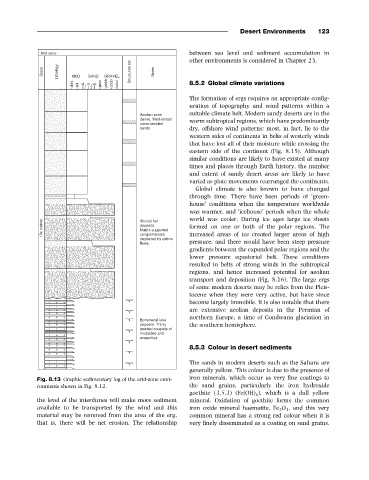
                 Fig. 8.13 Graphic sedimentary log of the arid-zone envi-  iron minerals, which occur as very fine coatings to
                 ronments shown in Fig. 8.12.                 the sand grains, particularly the iron hydroxide
                                                              goethite (3.5.1) (Fe(OH) x ), which is a dull yellow
                 the level of the interdunes will make more sediment  mineral. Oxidation of goethite forms the common
                 available to be transported by the wind and this  iron oxide mineral haematite, Fe 2 O 3 , and this very
                 material may be removed from the area of the erg,  common mineral has a strong red colour when it is
                 that is, there will be net erosion. The relationship  very finely disseminated as a coating on sand grains.

