


Page 131 - Sedimentology and Stratigraphy
P. 131
118    Aeolian Environments


                  aeolianites, and these may be locally important com-  grains will not be picked up by the air flow and where
                  ponents of coastal deposition (McKee & Ward 1983).  few saltating grains land.
                                                                Aeolian ripples have extremely variable wave-
                                                              lengths (crest to crest distance) ranging from a few
                  8.4 AEOLIAN BEDFORMS
                                                              centimetres to several metres. Ripple heights (bottom
                                                              of the trough to the top of a crest) range from less than
                  The processes of transport and deposition by wind
                                                              a centimetre to more than ten centimetres. Coarser
                  produce bedforms that are in some ways similar to
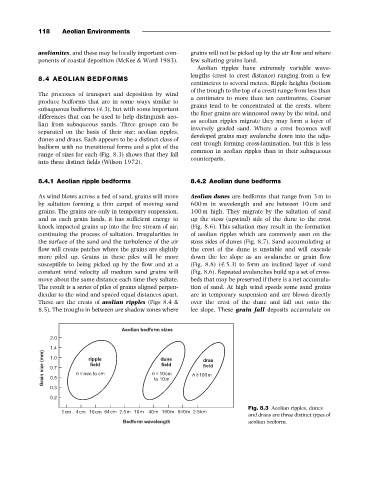
                  subaqueous bedforms (4.3), but with some important  grains tend to be concentrated at the crests, where
                  differences that can be used to help distinguish aeo-  the finer grains are winnowed away by the wind, and
                  lian from subaqueous sands. Three groups can be  as aeolian ripples migrate they may form a layer of
                  separated on the basis of their size: aeolian ripples,  inversely graded sand. Where a crest becomes well
                  dunes and draas. Each appears to be a distinct class of  developed grains may avalanche down into the adja-
                  bedform with no transitional forms and a plot of the  cent trough forming cross-lamination, but this is less
                  range of sizes for each (Fig. 8.3) shows that they fall  common in aeolian ripples than in their subaqueous
                  into three distinct fields (Wilson 1972).   counterparts.


                  8.4.1 Aeolian ripple bedforms               8.4.2 Aeolian dune bedforms

                  As wind blows across a bed of sand, grains will move  Aeolian dunes are bedforms that range from 3 m to
                  by saltation forming a thin carpet of moving sand  600 m in wavelength and are between 10 cm and
                  grains. The grains are only in temporary suspension,  100 m high. They migrate by the saltation of sand
                  and as each grain lands, it has sufficient energy to  up the stoss (upwind) side of the dune to the crest
                  knock impacted grains up into the free stream of air,  (Fig. 8.6). This saltation may result in the formation
                  continuing the process of saltation. Irregularities in  of aeolian ripples which are commonly seen on the
                  the surface of the sand and the turbulence of the air  stoss sides of dunes (Fig. 8.7). Sand accumulating at
                  flow will create patches where the grains are slightly  the crest of the dune is unstable and will cascade
                  more piled up. Grains in these piles will be more  down the lee slope as an avalanche or grain flow
                  susceptible to being picked up by the flow and at a  (Fig. 8.8) (4.5.3) to form an inclined layer of sand
                  constant wind velocity all medium sand grains will  (Fig. 8.6). Repeated avalanches build up a set of cross-
                  move about the same distance each time they saltate.  beds that may be preserved if there is a net accumula-
                  The result is a series of piles of grains aligned perpen-  tion of sand. At high wind speeds some sand grains
                  dicular to the wind and spaced equal distances apart.  are in temporary suspension and are blown directly
                  These are the crests of aeolian ripples (Figs 8.4 &  over the crest of the dune and fall out onto the
                  8.5). The troughs in between are shadow zones where  lee slope. These grain fall deposits accumulate on


                        	    	             "

     "
     #


                                                                               Fig. 8.3 Aeolian ripples, dunes


                               !
                                                                               and draas are three distinct types of


                        aeolian bedform.

