


Page 132 - Sedimentology and Stratigraphy
P. 132
Aeolian Bedforms    119


 $
$
   	 %
                                                             %
   %
   	 %
                                  %  &
   	 %
%

  % %


                                                  $
   	 %
%       &    	    %  '
   & &

  %


      %         $


 	    %
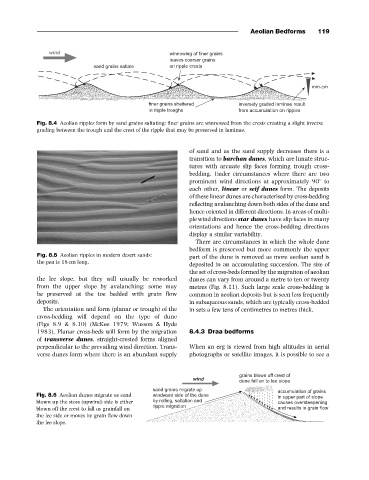
                 Fig. 8.4 Aeolian ripples form by sand grains saltating: finer grains are winnowed from the crests creating a slight inverse
                 grading between the trough and the crest of the ripple that may be preserved in laminae.

                                                              of sand and as the sand supply decreases there is a
                                                              transition to barchan dunes, which are lunate struc-
                                                              tures with arcuate slip faces forming trough cross-
                                                              bedding. Under circumstances where there are two
                                                              prominent wind directions at approximately 908 to
                                                              each other, linear or seif dunes form. The deposits
                                                              of these linear dunes are characterised by cross-bedding
                                                              reflecting avalanching down both sides of the dune and
                                                              hence oriented in different directions. In areas of multi-
                                                              ple wind directions star dunes have slip faces in many
                                                              orientations and hence the cross-bedding directions
                                                              display a similar variability.
                                                               There are circumstances in which the whole dune
                                                              bedform is preserved but more commonly the upper
                 Fig. 8.5 Aeolian ripples in modern desert sands:  part of the dune is removed as more aeolian sand is
                 the pen is 18 cm long.
                                                              deposited in an accumulating succession. The size of
                                                              the set of cross-beds formed by the migration of aeolian
                 the lee slope, but they will usually be reworked  dunes can vary from around a metre to ten or twenty
                 from the upper slope by avalanching: some may  metres (Fig. 8.11). Such large scale cross-bedding is
                 be preserved at the toe bedded with grain flow  common in aeolian deposits but is seen less frequently
                 deposits.                                    in subaqueous sands, which are typically cross-bedded
                   The orientation and form (planar or trough) of the  in sets a few tens of centimetres to metres thick.
                 cross-bedding will depend on the type of dune
                 (Figs 8.9 & 8.10) (McKee 1979; Wasson & Hyde
                 1983). Planar cross-beds will form by the migration  8.4.3 Draa bedforms
                 of transverse dunes, straight-crested forms aligned
                 perpendicular to the prevailing wind direction. Trans-  When an erg is viewed from high altitudes in aerial
                 verse dunes form where there is an abundant supply  photographs or satellite images, it is possible to see a


                                                                               	 %

 $$
  %
 $
                                                                            &
$


%
                                                   %  &
   	 %


 $
   	 %
                 Fig. 8.6 Aeolian dunes migrate as sand   	 &   &
%	&
 $

&


 $
%
                                                    '
    	  (
%
  &
                 blown up the stoss (upwind) side is either
  % %
    %

                 blown off the crest to fall as grainfall on                             &
  %   %


$
                 the lee side or moves by grain flow down
                 the lee slope.

