


Page 129 - Sedimentology and Stratigraphy
P. 129
116    Aeolian Environments


                  accumulations of aeolian dust are relatively uncom-
                  mon (8.6.2), but airborne material can be literally
                  carried around the world by winds and be deposited
                  in all depositional environments.


                  8.2 DESERTS AND ERGS
                  A desert is a continental area that receives little
                  precipitation: they are arid areas that receive less
                  than 250 mm yr  1  precipitation. (Areas that receive
                  average precipitation of between 250 and 500 mm
                  yr  1  are defined as semi-arid and are not usually
                  considered to be true deserts.) This definition of a
                  desert does consider temperature to be a factor, for,
                  although the ‘classic’ deserts of the world today, such
                  as the Sahara, are hot as well as dry places, there are
                  also many dry areas that are also cold, including
                  ‘polar deserts’ of high latitudes. The shortage of
                  water limits the quantity and diversity of life in a
                  desert: only a relatively limited range of plants and
                  animals have adapted to live under these dry condi-
                  tions and large parts of a desert surface are devoid of
                  vegetation. The lack of vegetation is an important
                  influence on surface processes because without a
                  plant cover detritus lies loose on the surface where it
                  is subject to aeolian activity.
                    An erg is an area where sand has accumulated as
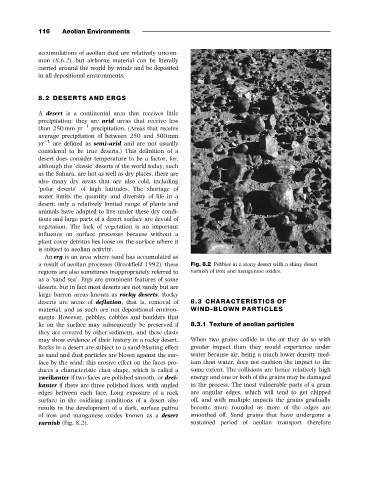
                  a result of aeolian processes (Brookfield 1992): these  Fig. 8.2 Pebbles in a stony desert with a shiny desert
                  regions are also sometimes inappropriately referred to  varnish of iron and manganese oxides.
                  as a ‘sand sea’. Ergs are prominent features of some
                  deserts, but in fact most deserts are not sandy but are
                  large barren areas known as rocky deserts. Rocky
                  deserts are areas of deflation, that is, removal of  8.3 CHARACTERISTICS OF
                  material, and as such are not depositional environ-  WIND-BLOWN PARTICLES
                  ments. However, pebbles, cobbles and boulders that
                  lie on the surface may subsequently be preserved if  8.3.1 Texture of aeolian particles
                  they are covered by other sediment, and these clasts
                  may show evidence of their history in a rocky desert.  When two grains collide in the air they do so with
                  Rocks in a desert are subject to a sand-blasting effect  greater impact than they would experience under
                  as sand and dust particles are blown against the sur-  water because air, being a much lower density med-
                  face by the wind: this erosive effect on the faces pro-  ium than water, does not cushion the impact to the
                  duces a characteristic clast shape, which is called a  same extent. The collisions are hence relatively high
                  zweikanter if two faces are polished smooth, or drei-  energy and one or both of the grains may be damaged
                  kanter if there are three polished faces, with angled  in the process. The most vulnerable parts of a grain
                  edges between each face. Long exposure of a rock  are angular edges, which will tend to get chipped
                  surface in the oxidising conditions of a desert also  off, and with multiple impacts the grains gradually
                  results in the development of a dark, surface patina  become more rounded as more of the edges are
                  of iron and manganese oxides known as a desert  smoothed off. Sand grains that have undergone a
                  varnish (Fig. 8.2).                         sustained period of aeolian transport therefore

