


Page 124 - Sedimentology and Stratigraphy
P. 124
Marine Glacial Environments   111


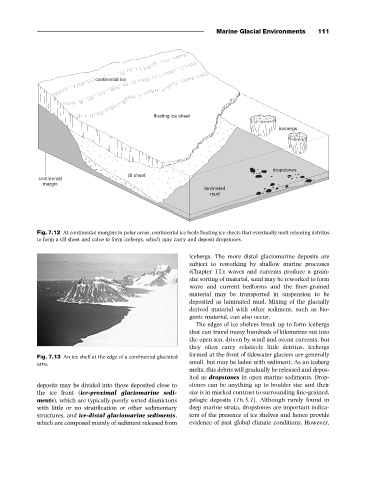
                 Fig. 7.12 At continental margins in polar areas, continental ice feeds floating ice sheets that eventually melt releasing detritus
                 to form a till sheet and calve to form icebergs, which may carry and deposit dropstones.
                                                              icebergs. The more distal glaciomarine deposits are
                                                              subject to reworking by shallow marine processes
                                                              (Chapter 11): waves and currents produce a grain-
                                                              size sorting of material, sand may be reworked to form
                                                              wave and current bedforms and the finer-grained
                                                              material may be transported in suspension to be
                                                              deposited as laminated mud. Mixing of the glacially
                                                              derived material with other sediment, such as bio-
                                                              genic material, can also occur.
                                                               The edges of ice shelves break up to form icebergs
                                                              that can travel many hundreds of kilometres out into
                                                              the open sea, driven by wind and ocean currents, but
                                                              they often carry relatively little detritus. Icebergs
                                                              formed at the front of tidewater glaciers are generally
                 Fig. 7.13 An ice shelf at the edge of a continental glaciated
                 area.                                        small, but may be laden with sediment. As an iceberg
                                                              melts, this debris will gradually be released and depos-
                                                              ited as dropstones in open marine sediments. Drop-
                 deposits may be divided into those deposited close to  stones can be anything up to boulder size and their
                 the ice front (ice-proximal glaciomarine sedi-  size is in marked contrast to surrounding fine-grained,
                 ments), which are typically poorly sorted diamictons  pelagic deposits (16.5.1). Although rarely found in
                 with little or no stratification or other sedimentary  deep marine strata, dropstones are important indica-
                 structures, and ice-distal glaciomarine sediments,  tors of the presence of ice shelves and hence provide
                 which are composed mainly of sediment released from  evidence of past global climate conditions. However,

