


Page 123 - Sedimentology and Stratigraphy
P. 123
110    Glacial Environments


                  Quaternary age (loess – 8.6.2) are thought to be  tinent extend hundreds of kilometres out to sea form-
                  sourced from periglacial environments. Clasts exposed  ing areas of floating ice which cover several hundred
                  on the outwash plain may be abraded by wind-blown  thousand square kilometres (Drewry 1986). These ice
                  sediment to form ventifacts (8.2).          shelves partially act to buffer the seaward flow of
                                                              continental ice: melting of the floating ice of an ice
                                                              shelf does not add any volume to the oceans, but if
                  7.4.4 Periglacial areas                     they are removed then more continental ice will flow
                                                              into the sea and this will cause sea level rise. Ice
                  In polar regions the areas that lie adjacent to ice  shelves such as those around the Antarctic contain
                  masses are referred to as the periglacial zone  relatively small amounts of sediment because there is
                  (6.6.2). In this area the temperature is below zero  little exposed rock to provide supraglacial detritus, so
                  for much of the year and the ground is largely frozen  the main source is basal debris. Ice shelves break up at
                  to create a region of permafrost. Only the soil and  the edges to form icebergs and melt at the base in
                  sediment near the surface thaws during the summer,  contact with seawater. Ice in a marine setting also
                  and to a depth of only a few tens of centimetres, below  occurs where temperate or poythermal valley glaciers
                  which the ground remains perennially frozen. The  flow down to sea level: these tidewater glaciers can
                  thin layer of thawed material is often waterlogged  contain large amounts of both supraglacial and basal
                  because the water cannot drain away into the frozen  debris. Sea ice is frozen seawater and does not contain
                  subsurface. This upper mobile layer can be unstable  any sedimentary material except for wind-blown dust.
                  on slopes and will slump or flow downslope. Other
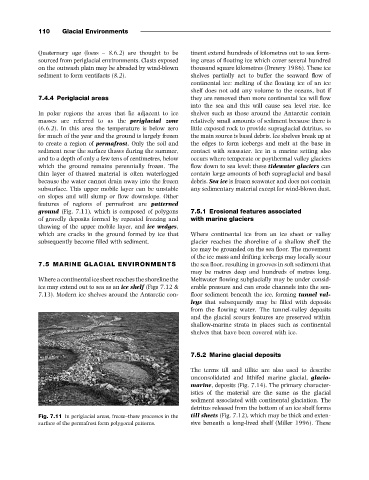
                  features of regions of permafrost are patterned
                  ground (Fig. 7.11), which is composed of polygons  7.5.1 Erosional features associated
                  of gravelly deposits formed by repeated freezing and  with marine glaciers
                  thawing of the upper mobile layer, and ice wedges,
                  which are cracks in the ground formed by ice that  Where continental ice from an ice sheet or valley
                  subsequently become filled with sediment.   glacier reaches the shoreline of a shallow shelf the
                                                              ice may be grounded on the sea floor. The movement
                                                              of the ice mass and drifting icebergs may locally scour
                  7.5 MARINE GLACIAL ENVIRONMENTS             the sea floor, resulting in grooves in soft sediment that
                                                              may be metres deep and hundreds of metres long.
                  Where a continental ice sheet reaches the shoreline the  Meltwater flowing subglacially may be under consid-
                  ice may extend out to sea as an ice shelf (Figs 7.12 &  erable pressure and can erode channels into the sea-
                  7.13). Modern ice shelves around the Antarctic con-  floor sediment beneath the ice, forming tunnel val-
                                                              leys that subsequently may be filled with deposits
                                                              from the flowing water. The tunnel-valley deposits
                                                              and the glacial scours features are preserved within
                                                              shallow-marine strata in places such as continental
                                                              shelves that have been covered with ice.


                                                              7.5.2 Marine glacial deposits

                                                              The terms till and tillite are also used to describe
                                                              unconsolidated and lithifed marine glacial, glacio-
                                                              marine, deposits (Fig. 7.14). The primary character-
                                                              istics of the material are the same as the glacial
                                                              sediment associated with continental glaciation. The
                                                              detritus released from the bottom of an ice shelf forms
                  Fig. 7.11 In periglacial areas, freeze–thaw processes in the  till sheets (Fig. 7.12), which may be thick and exten-
                  surface of the permafrost form polygonal patterns.  sive beneath a long-lived shelf (Miller 1996). These

