


Page 128 - Sedimentology and Stratigraphy
P. 128
Aeolian Transport   115


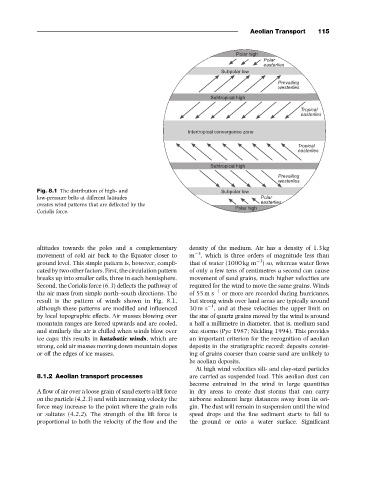
                 Fig. 8.1 The distribution of high- and
                 low-pressure belts at different latitudes
                 creates wind patterns that are deflected by the
                 Coriolis force.


                 altitudes towards the poles and a complementary  density of the medium. Air has a density of 1.3 kg
                 movement of cold air back to the Equator closer to  m  3 , which is three orders of magnitude less than
                 ground level. This simple pattern is, however, compli-  that of water (1000 kg m  3 ) so, whereas water flows
                 cated by two other factors. First, the circulation pattern  of only a few tens of centimetres a second can cause
                 breaks up into smaller cells, three in each hemisphere.  movement of sand grains, much higher velocities are
                 Second, the Coriolis force (6.3) deflects the pathway of  required for the wind to move the same grains. Winds
                 the air mass from simple north–south directions. The  of 55 m s  1  or more are recorded during hurricanes,
                 result is the pattern of winds shown in Fig. 8.1,  but strong winds over land areas are typically around
                 although these patterns are modified and influenced  30 m s  1 , and at these velocities the upper limit on
                 by local topographic effects. Air masses blowing over  the size of quartz grains moved by the wind is around
                 mountain ranges are forced upwards and are cooled,  a half a millimetre in diameter, that is, medium sand
                 and similarly the air is chilled when winds blow over  size storms (Pye 1987; Nickling 1994). This provides
                 ice caps: this results in katabatic winds, which are  an important criterion for the recognition of aeolian
                 strong, cold air masses moving down mountain slopes  deposits in the stratigraphic record: deposits consist-
                 or off the edges of ice masses.              ing of grains coarser than coarse sand are unlikely to
                                                              be aeolian deposits.
                                                               At high wind velocities silt- and clay-sized particles
                 8.1.2 Aeolian transport processes            are carried as suspended load. This aeolian dust can
                                                              become entrained in the wind in large quantities
                 A flow of air over a loose grain of sand exerts a lift force  in dry areas to create dust storms that can carry
                 on the particle (4.2.3) and with increasing velocity the  airborne sediment large distances away from its ori-
                 force may increase to the point where the grain rolls  gin. The dust will remain in suspension until the wind
                 or saltates (4.2.2). The strength of the lift force is  speed drops and the fine sediment starts to fall to
                 proportional to both the velocity of the flow and the  the ground or onto a water surface. Significant

