


Page 133 - Sedimentology and Stratigraphy
P. 133
120    Aeolian Environments


                                                              in amplitude. These structures are known as draas
                                                              and there is again evidence that they are a distinct,
                                                              larger bedform separate from the dunes that may be
                                                              superimposed on them (Wilson 1972). Draas are
                                                              usually made up of dunes on the stoss and lee sides,
                                                              but a single slip face may develop on some lee slopes.
                                                              They show a similar variability of shape to dunes with
                                                              star, linear and transverse forms.


                                                              8.4.4 Palaeowind directions

                                                              The slip faces of aeolian dunes generally face down-
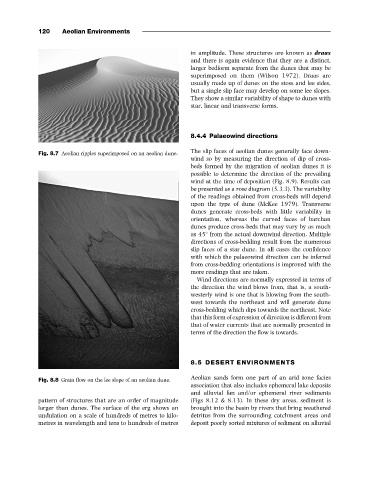
                  Fig. 8.7 Aeolian ripples superimposed on an aeolian dune.
                                                              wind so by measuring the direction of dip of cross-
                                                              beds formed by the migration of aeolian dunes it is
                                                              possible to determine the direction of the prevailing
                                                              wind at the time of deposition (Fig. 8.9). Results can
                                                              be presented as a rose diagram (5.3.3). The variability
                                                              of the readings obtained from cross-beds will depend
                                                              upon the type of dune (McKee 1979). Transverse
                                                              dunes generate cross-beds with little variability in
                                                              orientation, whereas the curved faces of barchan
                                                              dunes produce cross-beds that may vary by as much
                                                              as 458 from the actual downwind direction. Multiple
                                                              directions of cross-bedding result from the numerous
                                                              slip faces of a star dune. In all cases the confidence
                                                              with which the palaeowind direction can be inferred
                                                              from cross-bedding orientations is improved with the
                                                              more readings that are taken.
                                                                Wind directions are normally expressed in terms of
                                                              the direction the wind blows from, that is, a south-
                                                              westerly wind is one that is blowing from the south-
                                                              west towards the northeast and will generate dune
                                                              cross-bedding which dips towards the northeast. Note
                                                              that this form of expression of direction is different from
                                                              that of water currents that are normally presented in
                                                              terms of the direction the flow is towards.


                                                              8.5 DESERT ENVIRONMENTS
                                                              Aeolian sands form one part of an arid zone facies
                  Fig. 8.8 Grain flow on the lee slope of an aeolian dune.
                                                              association that also includes ephemeral lake deposits
                                                              and alluvial fan and/or ephemeral river sediments
                  pattern of structures that are an order of magnitude  (Figs 8.12 & 8.13). In these dry areas, sediment is
                  larger than dunes. The surface of the erg shows an  brought into the basin by rivers that bring weathered
                  undulation on a scale of hundreds of metres to kilo-  detritus from the surrounding catchment areas and
                  metres in wavelength and tens to hundreds of metres  deposit poorly sorted mixtures of sediment on alluvial

