


Page 125 - Sedimentology and Stratigraphy
P. 125
112    Glacial Environments


                   Marine glacial facies                        Extensive ice sheets are today confined to the polar
                                                              regions within the Arctic and Antarctic circles. Dur-
                   Scale  Lithology  MUD  SAND  GRAVEL  Structures etc  Notes  ing the glacial episodes of the Quaternary the polar ice
                                                              caps extended further into lower latitudes. The sea
                             clay  silt  vf m vc  gran  pebb  cobb  boul  level was lower during glacial periods and many
                                  c
                                f
                                                              parts of the continental shelves were under ice.
                                                              Upland glacial regions were also more extensive,
                                                              with ice reaching beyond the immediate vicinity of
                                                              the mountain glaciers. The growth of polar ice caps is
                                                              known to be related to global changes in climate, with
                                                Laminated muds
                                                with ice-rafted sands  the ice at its most extensive when the globe was
                                                and gravels as beds  several degrees cooler. Other glacial episodes are
                                                and isolated
                                                dropstones    known from the stratigraphic record to have occurred
                                                              in the late Carboniferous and Permian (the Gond-
                   10s metres                                 wana glaciation in the southern hemisphere), in the
                                                              early Palaeozoic and in the Proterozoic.


                                                              7.7 ICE, CLIMATE AND TECTONICS

                                                              7.7.1 Glaciation and global climate

                                                              The continental ice caps at and near the poles contain
                                                              the vast majority of the ice on the planet. The Ant-
                                                              arctic ice cap covers almost all of the continent and
                                                              has a fringe of floating ice shelves; much of the ice in
                                                              the Arctic is sea ice in the Arctic Ocean, but Green-
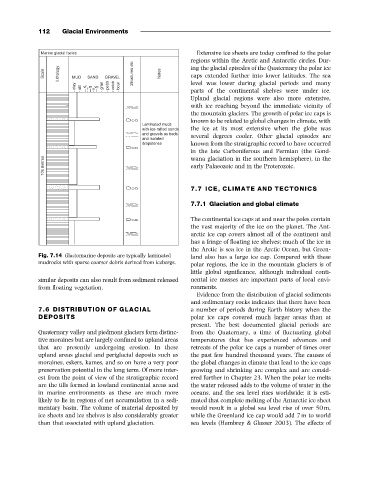
                  Fig. 7.14 Glaciomarine deposits are typically laminated  land also has a large ice cap. Compared with these
                  mudrocks with sparse coarser debris derived from icebergs.  polar regions, the ice in the mountain glaciers is of
                                                              little global significance, although individual conti-
                  similar deposits can also result from sediment released  nental ice masses are important parts of local envi-
                  from floating vegetation.                   ronments.
                                                                Evidence from the distribution of glacial sediments
                                                              and sedimentary rocks indicates that there have been
                  7.6 DISTRIBUTION OF GLACIAL                 a number of periods during Earth history when the
                  DEPOSITS                                    polar ice caps covered much larger areas than at
                                                              present. The best documented glacial periods are
                  Quaternary valley and piedmont glaciers form distinc-  from the Quaternary, a time of fluctuating global
                  tive moraines but are largely confined to upland areas  temperatures that has experienced advances and
                  that are presently undergoing erosion. In these  retreats of the polar ice caps a number of times over
                  upland areas glacial and periglacial deposits such as  the past few hundred thousand years. The causes of
                  moraines, eskers, kames, and so on have a very poor  the global changes in climate that lead to the ice caps
                  preservation potential in the long term. Of more inter-  growing and shrinking are complex and are consid-
                  est from the point of view of the stratigraphic record  ered further in Chapter 23. When the polar ice melts
                  are the tills formed in lowland continental areas and  the water released adds to the volume of water in the
                  in marine environments as these are much more  oceans, and the sea level rises worldwide: it is esti-
                  likely to lie in regions of net accumulation in a sedi-  mated that complete melting of the Antarctic ice sheet
                  mentary basin. The volume of material deposited by  would result in a global sea level rise of over 50 m,
                  ice sheets and ice shelves is also considerably greater  while the Greenland ice cap would add 7 m to world
                  than that associated with upland glaciation.  sea levels (Hambrey & Glasser 2003). The effects of

