


Page 122 - Sedimentology and Stratigraphy
P. 122
Continental Glacial Deposition  109


                                                              melts. Kames and kame terraces are mounds or
                                                              ridges of sediment formed by the collapse of crevasse
                                                              fills, sediment formed in lakes lying on the top of the
                                                              glacier or the products of the collapse of the edge of a
                                                              glacier.


                                                              7.4.3 Outwash plains

                                                              As the front of a glacier or ice sheet melts it releases
                                                              large volumes of water along with any detritus being
                                                              carried by the ice (Fig. 7.10). Rivers flow away from
                                                              the ice front over the broad area of the outwash
                                                              plain, also known by their Icelandic name sandur
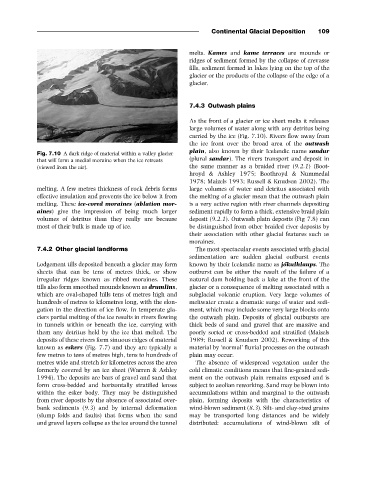
                 Fig. 7.10 A dark ridge of material within a valley glacier
                 that will form a medial moraine when the ice retreats  (plural sandar). The rivers transport and deposit in
                 (viewed from the air).                       the same manner as a braided river (9.2.1) (Boot-
                                                              hroyd & Ashley 1975; Boothroyd & Nummedal
                                                              1978; Maizels 1993; Russell & Knudsen 2002). The
                 melting. A few metres thickness of rock debris forms  large volumes of water and detritus associated with
                 effective insulation and prevents the ice below it from  the melting of a glacier mean that the outwash plain
                 melting. These ice-cored moraines (ablation mor-  is a very active region with river channels depositing
                 aines) give the impression of being much larger  sediment rapidly to form a thick, extensive braid plain
                 volumes of detritus than they really are because  deposit (9.2.1). Outwash plain deposits (Fig 7.8) can
                 most of their bulk is made up of ice.        be distinguished from other braided river deposits by
                                                              their association with other glacial features such as
                                                              moraines.
                 7.4.2 Other glacial landforms                 The most spectacular events associated with glacial
                                                              sedimentation are sudden glacial outburst events
                 Lodgement tills deposited beneath a glacier may form  known by their Icelandic name as jo¨kulhlaups. The
                 sheets that can be tens of metres thick, or show  outburst can be either the result of the failure of a
                 irregular ridges known as ribbed moraines. These  natural dam holding back a lake at the front of the
                 tills also form smoothed mounds known as drumlins,  glacier or a consequence of melting associated with a
                 which are oval-shaped hills tens of metres high and  subglacial volcanic eruption. Very large volumes of
                 hundreds of metres to kilometres long, with the elon-  meltwater create a dramatic surge of water and sedi-
                 gation in the direction of ice flow. In temperate gla-  ment, which may include some very large blocks onto
                 ciers partial melting of the ice results in rivers flowing  the outwash plain. Deposits of glacial outbursts are
                 in tunnels within or beneath the ice, carrying with  thick beds of sand and gravel that are massive and
                 them any detritus held by the ice that melted. The  poorly sorted or cross-bedded and stratified (Maizels
                 deposits of these rivers form sinuous ridges of material  1989; Russell & Knudsen 2002). Reworking of this
                 known as eskers (Fig. 7.7) and they are typically a  material by ‘normal’ fluvial processes on the outwash
                 few metres to tens of metres high, tens to hundreds of  plain may occur.
                 metres wide and stretch for kilometres across the area  The absence of widespread vegetation under the
                 formerly covered by an ice sheet (Warren & Ashley  cold climatic conditions means that fine-grained sedi-
                 1994). The deposits are bars of gravel and sand that  ment on the outwash plain remains exposed and is
                 form cross-bedded and horizontally stratified lenses  subject to aeolian reworking. Sand may be blown into
                 within the esker body. They may be distinguished  accumulations within and marginal to the outwash
                 from river deposits by the absence of associated over-  plain, forming deposits with the characteristics of
                 bank sediments (9.3) and by internal deformation  wind-blown sediment (8.3). Silt- and clay-sized grains
                 (slump folds and faults) that forms when the sand  may be transported long distances and be widely
                 and gravel layers collapse as the ice around the tunnel  distributed: accumulations of wind-blown silt of

