


Page 118 - Sedimentology and Stratigraphy
P. 118
Glaciers   105


                 the lower parts. Because little or no movement takes
                 place at the interface of the ice and the substrate, the
                 glacier does not remove material from the valley floor
                 or sides by glacial erosion. Cold glaciers are therefore
                 less important than polythermal and temperate
                 glaciers in terms of erosion and transport of sediment.
                 Material carried by cold glaciers is largely detritus
                 that has fallen under gravity down the upper part of
                 the valley sides and comes to rest on the top of the
                 glacier.
                 Polythermal glaciers are cold-based most of the
                 time, but as snow and ice accumulate in the upper
                 part of the glacier, the pressure near the base of it
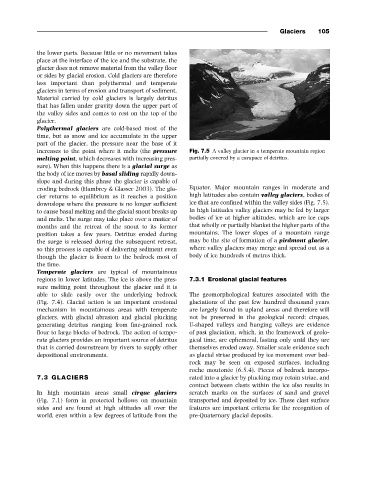
                 increases to the point where it melts (the pressure  Fig. 7.5 A valley glacier in a temperate mountain region
                 melting point, which decreases with increasing pres-  partially covered by a carapace of detritus.
                 sure). When this happens there is a glacial surge as
                 the body of ice moves by basal sliding rapidly down-
                 slope and during this phase the glacier is capable of
                 eroding bedrock (Hambrey & Glasser 2003). The gla-  Equator. Major mountain ranges in moderate and
                 cier returns to equilibrium as it reaches a position  high latitudes also contain valley glaciers, bodies of
                 downslope where the pressure is no longer sufficient  ice that are confined within the valley sides (Fig. 7.5).
                 to cause basal melting and the glacial snout breaks up  In high latitudes valley glaciers may be fed by larger
                 and melts. The surge may take place over a matter of  bodies of ice at higher altitudes, which are ice caps
                 months and the retreat of the snout to its former  that wholly or partially blanket the higher parts of the
                 position takes a few years. Detritus eroded during  mountains. The lower slopes of a mountain range
                 the surge is released during the subsequent retreat,  may be the site of formation of a piedmont glacier,
                 so this process is capable of delivering sediment even  where valley glaciers may merge and spread out as a
                 though the glacier is frozen to the bedrock most of  body of ice hundreds of metres thick.
                 the time.
                 Temperate glaciers are typical of mountainous
                 regions in lower latitudes. The ice is above the pres-  7.3.1 Erosional glacial features
                 sure melting point throughout the glacier and it is
                 able to slide easily over the underlying bedrock  The geomorphological features associated with the
                 (Fig. 7.4). Glacial action is an important erosional  glaciations of the past few hundred thousand years
                 mechanism in mountainous areas with temperate  are largely found in upland areas and therefore will
                 glaciers, with glacial abrasion and glacial plucking  not be preserved in the geological record: cirques,
                 generating detritus ranging from fine-grained rock  U-shaped valleys and hanging valleys are evidence
                 flour to large blocks of bedrock. The action of tempe-  of past glaciation, which, in the framework of geolo-
                 rate glaciers provides an important source of detritus  gical time, are ephemeral, lasting only until they are
                 that is carried downstream by rivers to supply other  themselves eroded away. Smaller scale evidence such
                 depositional environments.                   as glacial striae produced by ice movement over bed-
                                                              rock may be seen on exposed surfaces, including
                                                              roche moutone ´e(6.5.4). Pieces of bedrock incorpo-
                 7.3 GLACIERS                                 rated into a glacier by plucking may retain striae, and
                                                              contact between clasts within the ice also results in
                 In high mountain areas small cirque glaciers  scratch marks on the surfaces of sand and gravel
                 (Fig. 7.1) form in protected hollows on mountain  transported and deposited by ice. These clast surface
                 sides and are found at high altitudes all over the  features are important criteria for the recognition of
                 world, even within a few degrees of latitude from the  pre-Quaternary glacial deposits.

