


Page 119 - Sedimentology and Stratigraphy
P. 119
106    Glacial Environments


                  7.3.2 Transport by continental glaciers     7.3.3  Deposition by continental glaciers
                  Debris is incorporated into a moving ice mass by two  The general term for all deposits directly deposited by
                  main mechanisms: supraglacial debris, which  ice is till if it is unconsolidated or tillite if it is lithified.
                  accumulates on the surface of a glacier as a result of  These terms are genetic, that is, they imply a process
                  detritus falling down the sides of the glacial valley,  of deposition and should therefore not be used as
                  and basal debris, which is entrained by processes of  purely descriptive terms: for example, a bed may be
                  abrasion and plucking from bedrock by moving ice.  described as a matrix-supported conglomerate (2.2.2),
                  Supraglacial debris is dominantly coarser-grained  but because a deposit of this description could be
                  material with a low proportion of fine-grained sedi-  formed by a number of different mechanisms in differ-
                  ment. Basal debris has a wider range of grain sizes,  ent environments (e.g. on alluvial fans, 9.5 and asso-
                  including fine-grained rock flour (6.5.4) produced by  ciated with submarine slumps, 16.1.2), the beds may
                  abrasion processes.                         or may not be interpreted as a tillite. To overcome this
                    This basal debris of very fine to coarse material  problem, the terms diamicton and diamictite are
                  tends to be most abundant in polythermal glaciers  commonly used to describe unlithified and lithified
                  because the alternation of pressure melting and freez-  deposits of poorly sorted material in an objective
                  ing of the ice in contact with the bedrock exerts a  way, without necessarily implying that the deposits
                  strong freeze–thaw weathering effect (6.4.1). Melt  are glacial in origin. (It is noteworthy, however, that
                  water between the glacier and the bedrock forms a  these terms, along with diamict for both unlithified
                  lubrication zone allowing the ice to move more freely  and lithifed material, are rarely used by sedimentolo-
                  and there is less erosion by the ice. Cold glaciers move  gists for deposits of pre-Quaternary age, and hence
                  only by internal deformation and hence do not erode  their use tends to be associated with glacial facies.)
                  bedrock. Cold and temperate glaciers therefore carry  Tills can be divided into a number of different types
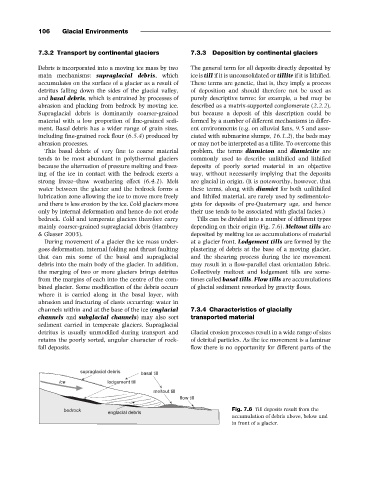
                  mainly coarser-grained supraglacial debris (Hambrey  depending on their origin (Fig. 7.6). Meltout tills are
                  & Glasser 2003).                            deposited by melting ice as accumulations of material
                    During movement of a glacier the ice mass under-  at a glacier front. Lodgement tills are formed by the
                  goes deformation, internal folding and thrust faulting  plastering of debris at the base of a moving glacier,
                  that can mix some of the basal and supraglacial  and the shearing process during the ice movement
                  debris into the main body of the glacier. In addition,  may result in a flow-parallel clast orientation fabric.
                  the merging of two or more glaciers brings detritus  Collectively meltout and lodgement tills are some-
                  from the margins of each into the centre of the com-  times called basal tills. Flow tills are accumulations
                  bined glacier. Some modification of the debris occurs  of glacial sediment reworked by gravity flows.
                  where it is carried along in the basal layer, with
                  abrasion and fracturing of clasts occurring: water in
                  channels within and at the base of the ice (englacial  7.3.4 Characteristics of glacially
                  channels and subglacial channels) may also sort  transported material
                  sediment carried in temperate glaciers. Supraglacial
                  detritus is usually unmodified during transport and  Glacial erosion processes result in a wide range of sizes
                  retains the poorly sorted, angular character of rock-  of detrital particles. As the ice movement is a laminar
                  fall deposits.                              flow there is no opportunity for different parts of the


                           Fig. 7.6 Till deposits result from the
                                                                          accumulation of debris above, below and
                                                                          in front of a glacier.

