


Page 116 - Sedimentology and Stratigraphy
P. 116
Distribution of Glacial Environments  103


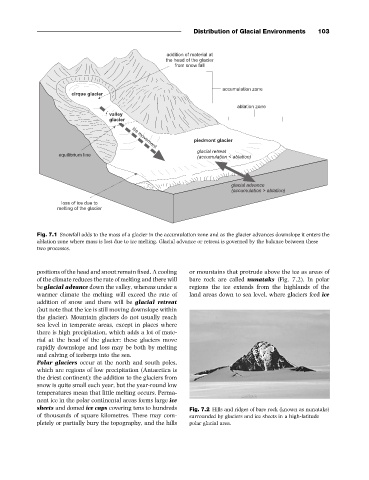
                 Fig. 7.1 Snowfall adds to the mass of a glacier in the accumulation zone and as the glacier advances downslope it enters the
                 ablation zone where mass is lost due to ice melting. Glacial advance or retreat is governed by the balance between these
                 two processes.


                 positions of the head and snout remain fixed. A cooling  or mountains that protrude above the ice as areas of
                 of the climate reduces the rate of melting and there will  bare rock are called nunataks (Fig. 7.2). In polar
                 be glacial advance down the valley, whereas under a  regions the ice extends from the highlands of the
                 warmer climate the melting will exceed the rate of  land areas down to sea level, where glaciers feed ice
                 addition of snow and there will be glacial retreat
                 (but note that the ice is still moving downslope within
                 the glacier). Mountain glaciers do not usually reach
                 sea level in temperate areas, except in places where
                 there is high precipitation, which adds a lot of mate-
                 rial at the head of the glacier: these glaciers move
                 rapidly downslope and loss may be both by melting
                 and calving of icebergs into the sea.
                 Polar glaciers occur at the north and south poles,
                 which are regions of low precipitation (Antarctica is
                 the driest continent): the addition to the glaciers from
                 snow is quite small each year, but the year-round low
                 temperatures mean that little melting occurs. Perma-
                 nent ice in the polar continental areas forms large ice
                 sheets and domed ice caps covering tens to hundreds  Fig. 7.2 Hills and ridges of bare rock (known as nunataks)
                 of thousands of square kilometres. These may com-  surrounded by glaciers and ice sheets in a high-latitude
                 pletely or partially bury the topography, and the hills  polar glacial area.

