


Page 113 - Sedimentology and Stratigraphy
P. 113
100    Continents: Sources of Sediment


     	    	         	            ?
                                      	 "


$

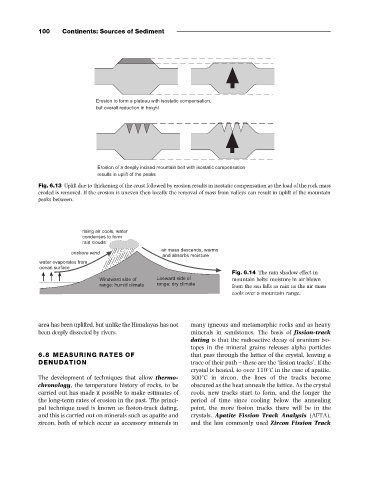
                  Fig. 6.13 Uplift due to thickening of the crust followed by erosion results in isostatic compensation as the load of the rock mass
                  eroded is removed. If the erosion is uneven then locally the removal of mass from valleys can result in uplift of the mountain
                  peaks between.


 ?


                                                        	    	        ?

                       	 "

                                                                          Fig. 6.14 The rain shadow effect in
                                    9
  >
     mountain belts: moisture in air blown
                                         @
            @	  $
       from the sea falls as rain as the air mass
                                                                          cools over a mountain range.


                  area has been uplifted, but unlike the Himalayas has not  many igneous and metamorphic rocks and as heavy
                  been deeply dissected by rivers.            minerals in sandstones. The basis of fission-track
                                                              dating is that the radioactive decay of uranium iso-
                                                              topes in the mineral grains releases alpha particles
                  6.8 MEASURING RATES OF                      that pass through the lattice of the crystal, leaving a
                  DENUDATION                                  trace of their path – these are the ‘fission tracks’. If the
                                                              crystal is heated, to over 1108C in the case of apatite,
                  The development of techniques that allow thermo-  3008C in zircon, the lines of the tracks become
                  chronology, the temperature history of rocks, to be  obscured as the heat anneals the lattice. As the crystal
                  carried out has made it possible to make estimates of  cools, new tracks start to form, and the longer the
                  the long-term rates of erosion in the past. The princi-  period of time since cooling below the annealing
                  pal technique used is known as fission-track dating,  point, the more fission tracks there will be in the
                  and this is carried out on minerals such as apatite and  crystals. Apatite Fission Track Analysis (AFTA),
                  zircon, both of which occur as accessory minerals in  and the less commonly used Zircon Fission Track

