


Page 110 - Sedimentology and Stratigraphy
P. 110
Denudation and Landscape Evolution   97


                 saturate the regolith and promote slumping on  breakdown, whereas mafic rocks such as basalts are
                 slopes. Repeated freezing and thawing of the regolith  rapidly weathered and eroded. Large amounts of clay
                 may also lead to creep downslope. Wind ablation is  minerals are generated by the denudation of terrains
                 important because of the sparse vegetation cover in  such as volcanic arcs, which are composed mainly of
                 subarctic areas.                             basaltic to andesitic rocks. Under extreme chemical
                                                              weathering of silicate rocks deep lateritic soils develop:
                                                              laterites are red soils composed mainly of iron oxides
                 Temperate regions
                                                              and aluminium oxides.
                 In temperate climates both physical and chemical  Limestone bedrock is primarily weathered by disso-
                 weathering processes tend to be subdued. Erosion  lution, and the pattern of denudation is therefore
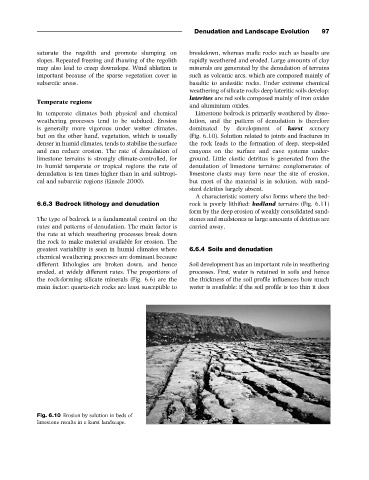
                 is generally more vigorous under wetter climates,  dominated  by  development  of  karst  scenery
                 but on the other hand, vegetation, which is usually  (Fig. 6.10). Solution related to joints and fractures in
                 denser in humid climates, tends to stabilise the surface  the rock leads to the formation of deep, steep-sided
                 and can reduce erosion. The rate of denudation of  canyons on the surface and cave systems under-
                 limestone terrains is strongly climate-controlled, for  ground. Little clastic detritus is generated from the
                 in humid temperate or tropical regions the rate of  denudation of limestone terrains: conglomerates of
                 denudation is ten times higher than in arid subtropi-  limestone clasts may form near the site of erosion,
                 cal and subarctic regions (Einsele 2000).    but most of the material is in solution, with sand-
                                                              sized detritus largely absent.
                                                               A characteristic scenery also forms where the bed-
                 6.6.3 Bedrock lithology and denudation       rock is poorly lithified: badland terrains (Fig. 6.11)
                                                              form by the deep erosion of weakly consolidated sand-
                 The type of bedrock is a fundamental control on the  stones and mudstones as large amounts of detritus are
                 rates and patterns of denudation. The main factor is  carried away.
                 the rate at which weathering processes break down
                 the rock to make material available for erosion. The
                 greatest variability is seen in humid climates where  6.6.4 Soils and denudation
                 chemical weathering processes are dominant because
                 different lithologies are broken down, and hence  Soil development has an important role in weathering
                 eroded, at widely different rates. The proportions of  processes. First, water is retained in soils and hence
                 the rock-forming silicate minerals (Fig. 6.6) are the  the thickness of the soil profile influences how much
                 main factor: quartz-rich rocks are least susceptible to  water is available: if the soil profile is too thin it does


                 Fig. 6.10 Erosion by solution in beds of
                 limestone results in a karst landscape.

