


Page 107 - Sedimentology and Stratigraphy
P. 107
94    Continents: Sources of Sediment


                  With sufficient water a slump may break up into a  from the surface and erode the regolith. The quantity
                  debris flow (4.5.1).                        of water involved and its carrying capacity depends
                                                              not only on the amount of rainfall but also the char-
                                                              acteristics of the surface: water runs faster down a
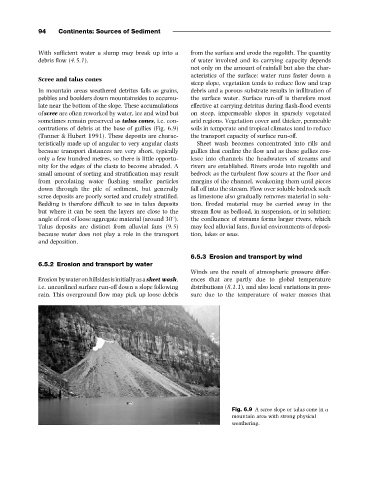
                  Scree and talus cones
                                                              steep slope, vegetation tends to reduce flow and trap
                  In mountain areas weathered detritus falls as grains,  debris and a porous substrate results in infiltration of
                  pebbles and boulders down mountainsides to accumu-  the surface water. Surface run-off is therefore most
                  late near the bottom of the slope. These accumulations  effective at carrying detritus during flash-flood events
                  of scree are often reworked by water, ice and wind but  on steep, impermeable slopes in sparsely vegetated
                  sometimes remain preserved as talus cones, i.e. con-  arid regions. Vegetation cover and thicker, permeable
                  centrations of debris at the base of gullies (Fig. 6.9)  soils in temperate and tropical climates tend to reduce
                  (Tanner & Hubert 1991). These deposits are charac-  the transport capacity of surface run-off.
                  teristically made up of angular to very angular clasts  Sheet wash becomes concentrated into rills and
                  because transport distances are very short, typically  gullies that confine the flow and as these gullies coa-
                  only a few hundred metres, so there is little opportu-  lesce into channels the headwaters of streams and
                  nity for the edges of the clasts to become abraded. A  rivers are established. Rivers erode into regolith and
                  small amount of sorting and stratification may result  bedrock as the turbulent flow scours at the floor and
                  from percolating water flushing smaller particles  margins of the channel, weakening them until pieces
                  down through the pile of sediment, but generally  fall off into the stream. Flow over soluble bedrock such
                  scree deposits are poorly sorted and crudely stratified.  as limestone also gradually removes material in solu-
                  Bedding is therefore difficult to see in talus deposits  tion. Eroded material may be carried away in the
                  but where it can be seen the layers are close to the  stream flow as bedload, in suspension, or in solution;
                  angle of rest of loose aggregate material (around 308).  the confluence of streams forms larger rivers, which
                  Talus deposits are distinct from alluvial fans (9.5)  may feed alluvial fans, fluvial environments of deposi-
                  because water does not play a role in the transport  tion, lakes or seas.
                  and deposition.
                                                              6.5.3 Erosion and transport by wind
                  6.5.2 Erosion and transport by water
                                                              Winds are the result of atmospheric pressure differ-
                  Erosionbywateronhillsidesisinitiallyasasheet wash,  ences that are partly due to global temperature
                  i.e. unconfined surface run-off down a slope following  distributions (8.1.1), and also local variations in pres-
                  rain. This overground flow may pick up loose debris  sure due to the temperature of water masses that


                                                                          Fig. 6.9 A scree slope or talus cone in a
                                                                          mountain area with strong physical
                                                                          weathering.

