


Page 106 - Sedimentology and Stratigraphy
P. 106
Erosion and Transport   93


                 form. Soil profiles become thicker through time as
                 bedrock is broken up and organic matter accumu-
                 lates, but a soil is also subject to erosion. Movement
                 under gravity and by the action of flowing water may

                 remove part or all of a soil profile. These erosion
                 processes may be acute on slopes and important on
                 flatter-lying ground where gullying may occur. The
                 soil becomes disaggregated and contributes detritus to
                 rivers. In temperate and humid tropical environments
                 most of the sediment carried in rivers is likely to have  !	 "
                 been part of a soil profile at some stage.
                   Continental depositional environments are also
                 sites of soil formation, especially the floodplains of

$
                 rivers. These soils may become buried by overlying
                 layers of sediment and are preserved in the strati-  !
                 graphic record as fossil soils (palaeosols: 9.7).

                                                                                          	      $
                 6.5 EROSION AND TRANSPORT                                           :

  ;

                 Weathering is the in situ breakdown of bedrock and  # $
                 erosion is the removal of regolith material. Loose
                 material on the land surface may be transported
                 downslope under gravity, it may be washed by
         $
                 water, blown away by wind, scoured by ice or
                 moved by a combination of these processes. Falls,

$ "
                 slides and slumps are responsible for moving vast
                 quantities of material downslope in mountain areas
                 but they do not move detritus very far, only down to
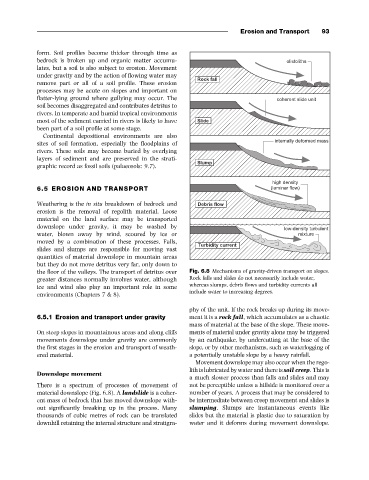
                 the floor of the valleys. The transport of detritus over  Fig. 6.8 Mechanisms of gravity-driven transport on slopes.
                 greater distances normally involves water, although  Rock falls and slides do not necessarily include water,
                                                              whereas slumps, debris flows and turbidity currents all
                 ice and wind also play an important role in some
                                                              include water to increasing degrees.
                 environments (Chapters 7 & 8).
                                                              phy of the unit. If the rock breaks up during its move-
                 6.5.1 Erosion and transport under gravity    ment it is a rock fall, which accumulates as a chaotic
                                                              mass of material at the base of the slope. These move-
                 On steep slopes in mountainous areas and along cliffs  ments of material under gravity alone may be triggered
                 movements downslope under gravity are commonly  by an earthquake, by undercutting at the base of the
                 the first stages in the erosion and transport of weath-  slope, or by other mechanisms, such as waterlogging of
                 ered material.                               a potentially unstable slope by a heavy rainfall.
                                                               Movement downslope may also occur when the rego-
                                                              lith is lubricated by water and there is soil creep. This is
                 Downslope movement
                                                              a much slower process than falls and slides and may
                 There is a spectrum of processes of movement of  not be perceptible unless a hillside is monitored over a
                 material downslope (Fig. 6.8). A landslide is a coher-  number of years. A process that may be considered to
                 ent mass of bedrock that has moved downslope with-  be intermediate between creep movement and slides is
                 out significantly breaking up in the process. Many  slumping. Slumps are instantaneous events like
                 thousands of cubic metres of rock can be translated  slides but the material is plastic due to saturation by
                 downhill retaining the internal structure and stratigra-  water and it deforms during movement downslope.

