


Page 111 - Sedimentology and Stratigraphy
P. 111
98    Continents: Sources of Sediment


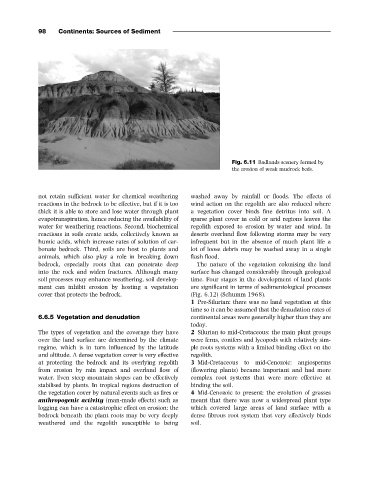
                                                                          Fig. 6.11 Badlands scenery formed by
                                                                          the erosion of weak mudrock beds.


                  not retain sufficient water for chemical weathering  washed away by rainfall or floods. The effects of
                  reactions in the bedrock to be effective, but if it is too  wind action on the regolith are also reduced where
                  thick it is able to store and lose water through plant  a vegetation cover binds fine detritus into soil. A
                  evapotranspiration, hence reducing the availability of  sparse plant cover in cold or arid regions leaves the
                  water for weathering reactions. Second, biochemical  regolith exposed to erosion by water and wind. In
                  reactions in soils create acids, collectively known as  deserts overland flow following storms may be very
                  humic acids, which increase rates of solution of car-  infrequent but in the absence of much plant life a
                  bonate bedrock. Third, soils are host to plants and  lot of loose debris may be washed away in a single
                  animals, which also play a role in breaking down  flash flood.
                  bedrock, especially roots that can penetrate deep  The nature of the vegetation colonising the land
                  into the rock and widen fractures. Although many  surface has changed considerably through geological
                  soil processes may enhance weathering, soil develop-  time. Four stages in the development of land plants
                  ment can inhibit erosion by hosting a vegetation  are significant in terms of sedimentological processes
                  cover that protects the bedrock.            (Fig. 6.12) (Schumm 1968).
                                                              1 Pre-Silurian: there was no land vegetation at this
                                                              time so it can be assumed that the denudation rates of
                  6.6.5 Vegetation and denudation             continental areas were generally higher than they are
                                                              today.
                  The types of vegetation and the coverage they have  2 Silurian to mid-Cretaceous: the main plant groups
                  over the land surface are determined by the climate  were ferns, conifers and lycopods with relatively sim-
                  regime, which is in turn influenced by the latitude  ple roots systems with a limited binding effect on the
                  and altitude. A dense vegetation cover is very effective  regolith.
                  at protecting the bedrock and its overlying regolith  3 Mid-Cretaceous to mid-Cenozoic: angiosperms
                  from erosion by rain impact and overland flow of  (flowering plants) became important and had more
                  water. Even steep mountain slopes can be effectively  complex root systems that were more effective at
                  stabilised by plants. In tropical regions destruction of  binding the soil.
                  the vegetation cover by natural events such as fires or  4 Mid-Cenozoic to present: the evolution of grasses
                  anthropogenic activity (man-made effects) such as  meant that there was now a widespread plant type
                  logging can have a catastrophic effect on erosion: the  which covered large areas of land surface with a
                  bedrock beneath the plant roots may be very deeply  dense fibrous root system that very effectively binds
                  weathered and the regolith susceptible to being  soil.

