


Page 147 - Sedimentology and Stratigraphy
P. 147
134    Rivers and Alluvial Fans


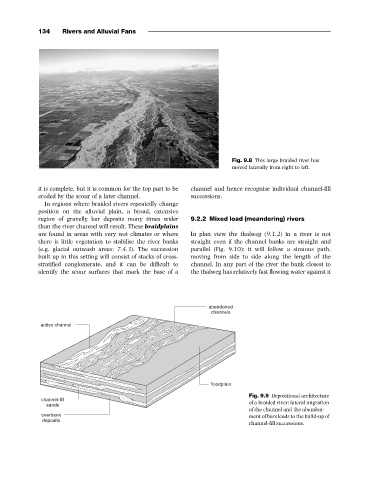
                                                                          Fig. 9.8 This large braided river has
                                                                          moved laterally from right to left.


                  it is complete, but it is common for the top part to be  channel and hence recognise individual channel-fill
                  eroded by the scour of a later channel.     successions.
                    In regions where braided rivers repeatedly change
                  position on the alluvial plain, a broad, extensive
                  region of gravelly bar deposits many times wider  9.2.2 Mixed load (meandering) rivers
                  than the river channel will result. These braidplains
                  are found in areas with very wet climates or where  In plan view the thalweg (9.1.2) in a river is not
                  there is little vegetation to stabilise the river banks  straight even if the channel banks are straight and
                  (e.g. glacial outwash areas: 7.4.3). The succession  parallel (Fig. 9.10): it will follow a sinuous path,
                  built up in this setting will consist of stacks of cross-  moving from side to side along the length of the
                  stratified conglomerate, and it can be difficult to  channel. In any part of the river the bank closest to
                  identify the scour surfaces that mark the base of a  the thalweg has relatively fast flowing water against it


                                                                               Fig. 9.9 Depositional architecture
                   	                                                           of a braided river: lateral migration

                                                                               of the channel and the abandon-
                                                                               ment of bars leads to the build-up of

                                                                               channel-fill successions.

