


Page 187 - Sedimentology and Stratigraphy
P. 187
174    The Marine Realm: Morphology and Processes


                                                              after it died. In some cases, the environmental condi-

                          tions might have actually caused the death of an
                                      	                       animal, such as a skeleton of a mammal enclosed in
                                                              volcanic ash. Most importantly, ichnofauna provide
                                                              precise information about the environment where
                                                              they were formed. For example, bird footprints are


    	      either evidence of a land surface, or of very shallow
                                                           "

       water where the bird may have been paddling, and a

     complex of burrows in sea-floor sediment is evidence
                                                              of oxygenated conditions. Trace fossils are therefore a
                                                              very powerful tool in palaeoenvironmental analysis,
                                 *
                                                              and we can use changes in trace fossil assemblages,
                        "                    !
                                                              known as ichnofacies, as evidence for changes in
                              ( 	               	             environment, such as rise and fall of sea level (23.8).


               11.7.2 Trace fossil assemblages
                                                              The ecology of the sea floor and hence the ichnofauna
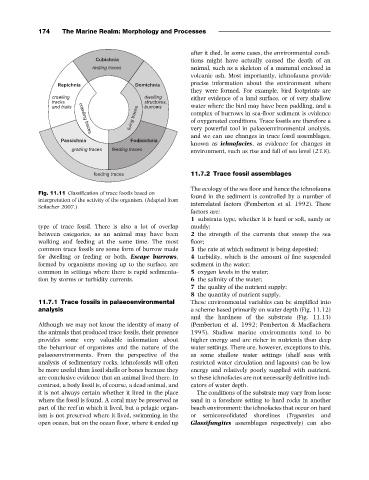
                  Fig. 11.11 Classification of trace fossils based on
                                                              found in the sediment is controlled by a number of
                  interpretation of the activity of the organism. (Adapted from
                                                              interrelated factors (Pemberton et al. 1992). These
                  Seilacher 2007.)
                                                              factors are:
                                                              1 substrata type, whether it is hard or soft, sandy or
                  type of trace fossil. There is also a lot of overlap  muddy;
                  between categories, as an animal may have been  2 the strength of the currents that sweep the sea
                  walking and feeding at the same time. The most  floor;
                  common trace fossils are some form of burrow made  3 the rate at which sediment is being deposited;
                  for dwelling or feeding or both. Escape burrows,  4 turbidity, which is the amount of fine suspended
                  formed by organisms moving up to the surface, are  sediment in the water;
                  common in settings where there is rapid sedimenta-  5 oxygen levels in the water;
                  tion by storms or turbidity currents.       6 the salinity of the water;
                                                              7 the quality of the nutrient supply;
                                                              8 the quantity of nutrient supply.
                  11.7.1 Trace fossils in palaeoenvironmental  These environmental variables can be simplified into
                  analysis                                    a scheme based primarily on water depth (Fig. 11.12)
                                                              and the hardness of the substrate (Fig. 11.13)
                  Although we may not know the identity of many of  (Pemberton et al. 1992; Pemberton & MacEachern
                  the animals that produced trace fossils, their presence  1995). Shallow marine environments tend to be
                  provides some very valuable information about  higher energy and are richer in nutrients than deep
                  the behaviour of organisms and the nature of the  water settings. There are, however, exceptions to this,
                  palaeoenvironments. From the perspective of the  as some shallow water settings (shelf seas with
                  analysis of sedimentary rocks, ichnofossils will often  restricted water circulation and lagoons) can be low
                  be more useful than fossil shells or bones because they  energy and relatively poorly supplied with nutrient,
                  are conclusive evidence that an animal lived there. In  so these ichnofacies are not necessarily definitive indi-
                  contrast, a body fossil is, of course, a dead animal, and  cators of water depth.
                  it is not always certain whether it lived in the place  The conditions of the substrate may vary from loose
                  where the fossil is found. A coral may be preserved as  sand in a foreshore setting to hard rocks in another
                  part of the reef in which it lived, but a pelagic organ-  beach environment: the ichnofacies that occur on hard
                  ism is not preserved where it lived, swimming in the  or  semiconsolidated  shorelines  (Trypanites  and
                  open ocean, but on the ocean floor, where it ended up  Glossifungites assemblages respectively) can also

