


Page 184 - Sedimentology and Stratigraphy
P. 184
Chemical and Biochemical Sedimentation in Oceans  171


                                            &


                                                 '


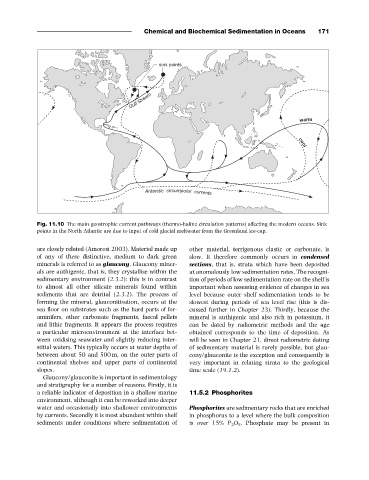
                 Fig. 11.10 The main geostrophic current pathways (thermo-haline circulation patterns) affecting the modern oceans. Sink
                 points in the North Atlantic are due to input of cold glacial meltwater from the Greenland ice-cap.

                 are closely related (Amorosi 2003). Material made up  other material, terrigenous clastic or carbonate, is
                 of any of these distinctive, medium to dark green  slow. It therefore commonly occurs in condensed
                 minerals is referred to as glaucony. Glaucony miner-  sections, that is, strata which have been deposited
                 als are authigenic, that is, they crystallise within the  at anomalously low sedimentation rates. The recogni-
                 sedimentary environment (2.3.2): this is in contrast  tion of periods of low sedimentation rate on the shelf is
                 to almost all other silicate minerals found within  important when assessing evidence of changes in sea
                 sediments that are detrital (2.3.1). The process of  level because outer shelf sedimentation tends to be
                 forming the mineral, glauconitisation, occurs at the  slowest during periods of sea level rise (this is dis-
                 sea floor on substrates such as the hard parts of for-  cussed further in Chapter 23). Thirdly, because the
                 aminifers, other carbonate fragments, faecal pellets  mineral is authigenic and also rich in potassium, it
                 and lithic fragments. It appears the process requires  can be dated by radiometric methods and the age
                 a particular microenvironment at the interface bet-  obtained corresponds to the time of deposition. As
                 ween oxidising seawater and slightly reducing inter-  will be seen in Chapter 21, direct radiometric dating
                 stitial waters. This typically occurs at water depths of  of sedimentary material is rarely possible, but glau-
                 between about 50 and 500 m, on the outer parts of  cony/glauconite is the exception and consequently is
                 continental shelves and upper parts of continental  very important in relating strata to the geological
                 slopes.                                      time scale (19.1.2).
                   Glaucony/glauconite is important in sedimentology
                 and stratigraphy for a number of reasons. Firstly, it is
                 a reliable indicator of deposition in a shallow marine  11.5.2 Phosphorites
                 environment, although it can be reworked into deeper
                 water and occasionally into shallower environments  Phosphorites are sedimentary rocks that are enriched
                 by currents. Secondly it is most abundant within shelf  in phosphorus to a level where the bulk composition
                 sediments under conditions where sedimentation of  is over 15% P 2 O 5 . Phosphate may be present in

