


Page 181 - Sedimentology and Stratigraphy
P. 181
168    The Marine Realm: Morphology and Processes


                  show a bimodal (two main directions of flow) and
                  bipolar (two opposite directions of flow) pattern. It
                  should be noted, however, that these opposing palaeo-
                  flow directions are not seen in all tidal sediments: first
                  the flow in one direction (either the ebb or flood tide)
                  may be much stronger than the other, and second the
                  two flows might be widely separated and only one
                  may have been active in the area examined (Dalrym-
                  ple & Choi 2007). Under favourable circumstances,
                  bipolar cross-stratification may be seen in a single
                  vertical section produced by alternating directions of
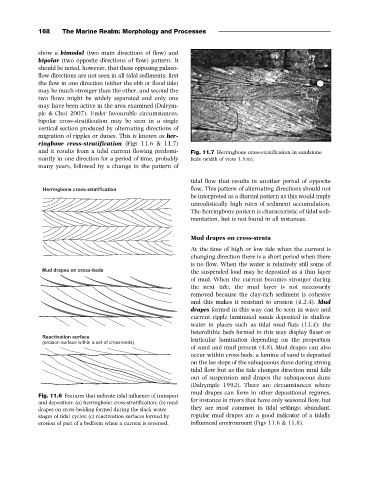
                  migration of ripples or dunes. This is known as her-
                  ringbone cross-stratification (Figs 11.6 & 11.7)
                  and it results from a tidal current flowing predomi-  Fig. 11.7 Herringbone cross-stratification in sandstone
                  nantly in one direction for a period of time, probably  beds (width of view 1.5 m).
                  many years, followed by a change in the pattern of

                                                              tidal flow that results in another period of opposite

                               flow. This pattern of alternating directions should not
                                                              be interpreted as a diurnal pattern as this would imply
                                                              unrealistically high rates of sediment accumulation.
                                                              The herringbone pattern is characteristic of tidal sedi-
                                                              mentation, but is not found in all instances.

                                                              Mud drapes on cross-strata
                                                              At the time of high or low tide when the current is
                                                              changing direction there is a short period when there
                                                              is no flow. When the water is relatively still some of


                             the suspended load may be deposited as a thin layer
                                                              of mud. When the current becomes stronger during
                                                              the next tide, the mud layer is not necessarily
                                                              removed because the clay-rich sediment is cohesive
                                                              and this makes it resistant to erosion (4.2.4). Mud
                                                              drapes formed in this way can be seen in wave and
                                                              current ripple laminated sands deposited in shallow
                                                              water in places such as tidal mud flats (13.4): the
                                                              heterolithic beds formed in this way display flaser or


                            lenticular lamination depending on the proportion
                   $


 *


  %
                                                              of sand and mud present (4.8). Mud drapes can also
                                                              occur within cross-beds: a lamina of sand is deposited
                                                              on the lee slope of the subaqueous dune during strong
                                                              tidal flow but as the tide changes direction mud falls
                                                              out of suspension and drapes the subaqueous dune
                                                              (Dalrymple 1992). There are circumstances where
                                                              mud drapes can form in other depositional regimes,
                  Fig. 11.6 Features that indicate tidal influence of transport
                                                              for instance in rivers that have only seasonal flow, but
                  and deposition: (a) herringbone cross-stratification; (b) mud
                  drapes on cross-bedding formed during the slack water  they are most common in tidal settings: abundant,
                  stages of tidal cycles; (c) reactivation surfaces formed by  regular mud drapes are a good indicator of a tidally
                  erosion of part of a bedform when a current is reversed.  influenced environment (Figs 11.6 & 11.8).

