


Page 178 - Sedimentology and Stratigraphy
P. 178
Tides    165


                 to this zone can also be applied at about 5000 m,  shelves. In some places it may be as little as 20 m
                 below which the deepest parts of the oceans are called  water depth but can be 50 to 200 m water depth
                 the hadal zone.                              if the shelf borders an ocean with a large fetch for
                   The shelf (neritic environment) can be usefully  storm waves. This deeper shelf area between the fair
                 further divided into depth-controlled zones (Fig. 11.2),  weather and storm wave bases is called the offshore-
                 although in this case the divisions are not defined  transition zone. The offshore zone is the region
                 by absolute depths, but the depths to which certain  below storm wave base and extends out to the shelf-
                 processes operate. Their range therefore varies  edge break at around 200 m depth.
                 according to the conditions in a particular basin  The activities of a number of physical, chemical and
                 because the depths to which tidal processes, waves  biological processes are determined by water depth,
                 and storms affect the shelf vary considerably. The  and in turn these influence the sediment accumula-
                 foreshore is the region between mean high water  tion on the different parts of the sea floor. The following
                 and mean low water marks of the tides. Depending  sections consider some of these processes and how they
                 on the tidal range (11.2.2) this may be a vertical  affect depositional environments.
                 distance of anything from a few tens of centimetres
                 to many metres. The seaward extent of the foreshore
                 is governed also by the slope and it may be anything
                 from a few metres, if the shelf is steeply sloping and/or  11.2 TIDES
                 the tidal range is small, to over a kilometre in places
                 where there is a high tidal range and a gently sloping  11.2.1 Tidal cycles
                 shelf. The foreshore is part of the beach environment
                 or littoral zone (13.2).                     According to Newton’s Law of Gravitation, all objects
                   The shoreface is defined as the region of the shelf  exert gravitational forces on each other, the strength
                 between the low-tide mark and the depth to which  of which is related to their masses and their distances
                 waves normally affect the sea bottom (4.4.1), and this  apart. The Moon exerts a gravitational force on the
                 is the fair weather wave base. The lower depth that  Earth and although ocean water is strongly attracted
                 the shoreface reaches depends on the energy of the  gravitationally to the Earth, it also experiences a small
                 waves in the area but is typically somewhere between  gravitational attraction from the Moon. The water
                 5 and 20 m. The width of the shoreface will be gov-  that is closest to the Moon experiences the largest
                 erned by the shelf slope as well as the depth of the fair  gravitational attraction and this creates a bulge of
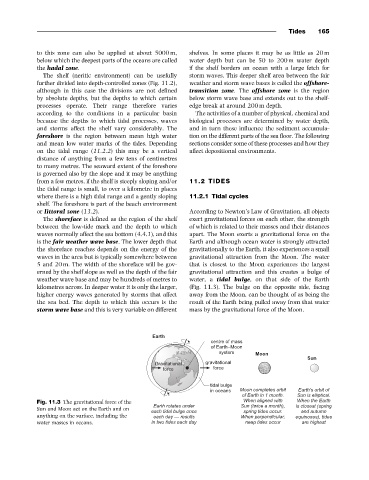
                 weather wave base and may be hundreds of metres to  water, a tidal bulge, on that side of the Earth
                 kilometres across. In deeper water it is only the larger,  (Fig. 11.3). The bulge on the opposite side, facing
                 higher energy waves generated by storms that affect  away from the Moon, can be thought of as being the
                 the sea bed. The depth to which this occurs is the  result of the Earth being pulled away from that water
                 storm wave base and this is very variable on different  mass by the gravitational force of the Moon.


 !    "#


#


                 Fig. 11.3 The gravitational force of the


!"
                 Sun and Moon act on the Earth and on

                 anything on the surface, including the

 	      	       "   $  	 %  !"
                 water masses in oceans.

