


Page 177 - Sedimentology and Stratigraphy
P. 177
164    The Marine Realm: Morphology and Processes


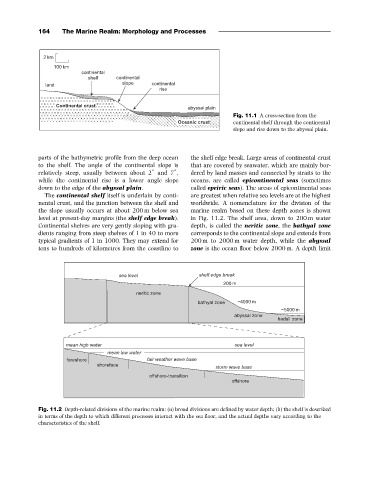
                                                                          Fig. 11.1 A cross-section from the


     continental shelf through the continental
                                                                          slope and rise down to the abyssal plain.


                  parts of the bathymetric profile from the deep ocean  the shelf edge break. Large areas of continental crust
                  to the shelf. The angle of the continental slope is  that are covered by seawater, which are mainly bor-
                  relatively steep, usually between about 2˚ and 7˚,  dered by land masses and connected by straits to the
                  while the continental rise is a lower angle slope  oceans, are called epicontinental seas (sometimes
                  down to the edge of the abyssal plain.      called epeiric seas). The areas of epicontinental seas
                    The continental shelf itself is underlain by conti-  are greatest when relative sea levels are at the highest
                  nental crust, and the junction between the shelf and  worldwide. A nomenclature for the division of the
                  the slope usually occurs at about 200 m below sea  marine realm based on these depth zones is shown
                  level at present-day margins (the shelf edge break).  in Fig. 11.2. The shelf area, down to 200 m water
                  Continental shelves are very gently sloping with gra-  depth, is called the neritic zone, the bathyal zone
                  dients ranging from steep shelves of 1 in 40 to more  corresponds to the continental slope and extends from
                  typical gradients of 1 in 1000. They may extend for  200 m to 2000 m water depth, while the abyssal
                  tens to hundreds of kilometres from the coastline to  zone is the ocean floor below 2000 m. A depth limit


                  Fig. 11.2 Depth-related divisions of the marine realm: (a) broad divisions are defined by water depth; (b) the shelf is described
                  in terms of the depth to which different processes interact with the sea floor, and the actual depths vary according to the
                  characteristics of the shelf.

