


Page 172 - Sedimentology and Stratigraphy
P. 172
Ephemeral Lakes    159


                          +    !


                          5


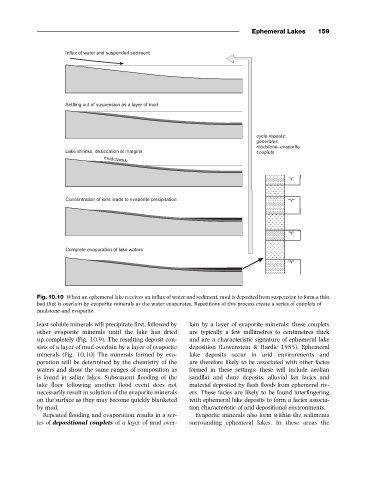
                 Fig. 10.10 When an ephemeral lake receives an influx of water and sediment, mud is deposited from suspension to form a thin
                 bed that is overlain by evaporite minerals as the water evaporates. Repetitions of this process create a series of couplets of
                 mudstone and evaporite.

                 least soluble minerals will precipitate first, followed by  lain by a layer of evaporite minerals: these couplets
                 other evaporite minerals until the lake has dried  are typically a few millimetres to centimetres thick
                 up completely (Fig. 10.9). The resulting deposit con-  and are a characteristic signature of ephemeral lake
                 sists of a layer of mud overlain by a layer of evaporite  deposition (Lowenstein & Hardie 1985). Ephemeral
                 minerals (Fig. 10.10) The minerals formed by eva-  lake deposits occur in arid environments and
                 poration will be determined by the chemistry of the  are therefore likely to be associated with other facies
                 waters and show the same ranges of composition as  formed in these settings: these will include aeolian
                 is found in saline lakes. Subsequent flooding of the  sandflat and dune deposits, alluvial fan facies and
                 lake floor following another flood event does not  material deposited by flash floods from ephemeral riv-
                 necessarily result in solution of the evaporite minerals  ers. These facies are likely to be found interfingering
                 on the surface as they may become quickly blanketed  with ephemeral lake deposits to form a facies associa-
                 by mud.                                      tion characteristic of arid depositional environments.
                   Repeated flooding and evaporation results in a ser-  Evaporite minerals also form within the sediments
                 ies of depositional couplets of a layer of mud over-  surrounding ephemeral lakes. In these areas the

