


Page 170 - Sedimentology and Stratigraphy
P. 170
Saline Lakes   157


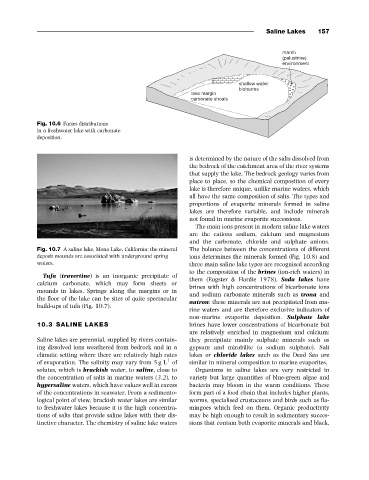
                 Fig. 10.6 Facies distributions
                 in a freshwater lake with carbonate
                 deposition.


                                                              is determined by the nature of the salts dissolved from
                                                              the bedrock of the catchment area of the river systems
                                                              that supply the lake. The bedrock geology varies from
                                                              place to place, so the chemical composition of every
                                                              lake is therefore unique, unlike marine waters, which
                                                              all have the same composition of salts. The types and
                                                              proportions of evaporite minerals formed in saline
                                                              lakes are therefore variable, and include minerals
                                                              not found in marine evaporite successions.
                                                               The main ions present in modern saline lake waters
                                                              are the cations sodium, calcium and magnesium
                                                              and the carbonate, chloride and sulphate anions.
                 Fig. 10.7 A saline lake, Mono Lake, California: the mineral  The balance between the concentrations of different
                 deposit mounds are associated with underground spring  ions determines the minerals formed (Fig. 10.8) and
                 waters.                                      three main saline lake types are recognised according
                                                              to the composition of the brines (ion-rich waters) in
                   Tufa (travertine) is an inorganic precipitate of  them (Eugster & Hardie 1978). Soda lakes have
                 calcium carbonate, which may form sheets or  brines with high concentrations of bicarbonate ions
                 mounds in lakes. Springs along the margins or in  and sodium carbonate minerals such as trona and
                 the floor of the lake can be sites of quite spectacular  natron: these minerals are not precipitated from ma-
                 build-ups of tufa (Fig. 10.7).
                                                              rine waters and are therefore exclusive indicators of
                                                              non-marine evaporite deposition. Sulphate lake
                 10.3 SALINE LAKES                            brines have lower concentrations of bicarbonate but
                                                              are relatively enriched in magnesium and calcium:
                 Saline lakes are perennial, supplied by rivers contain-  they precipitate mainly sulphate minerals such as
                 ing dissolved ions weathered from bedrock and in a  gypsum and mirabilite (a sodium sulphate). Salt
                 climatic setting where there are relatively high rates  lakes or chloride lakes such as the Dead Sea are
                                                        1
                 of evaporation. The salinity may vary from 5 g L of  similar in mineral composition to marine evaporites.
                 solutes, which is brackish water, to saline, close to  Organisms in saline lakes are very restricted in
                 the concentration of salts in marine waters (3.2), to  variety but large quantities of blue-green algae and
                 hypersaline waters, which have values well in excess  bacteria may bloom in the warm conditions. These
                 of the concentrations in seawater. From a sedimento-  form part of a food chain that includes higher plants,
                 logical point of view, brackish water lakes are similar  worms, specialised crustaceans and birds such as fla-
                 to freshwater lakes because it is the high concentra-  mingoes which feed on them. Organic productivity
                 tions of salts that provide saline lakes with their dis-  may be high enough to result in sedimentary succes-
                 tinctive character. The chemistry of saline lake waters  sions that contain both evaporite minerals and black,

