


Page 168 - Sedimentology and Stratigraphy
P. 168
Freshwater Lakes    155


                 source rock for oil and gas (18.7.3). The second effect  lake margin setting. This lake margin marshy envi-
                 of anaerobic bottom conditions is that this is an envi-  ronment is sometimes referred to as a palustrine
                 ronment that is unfavourable for life. Stratified lakes  environment. Plants and animals living in this setting
                 therefore have no animals living on the bottom or  live in and on the sediment in a wet soil environment
                 within the surface sediment and hence there is no  where sediments will be modified by soil (pedogenic)
                 bioturbation (11.7.3) to disturb the primary sedimen-  processes (9.7), resulting in a nodular texture that
                 tary layering.                               may sometimes be calcareous.


                 10.2.2 Lake margin clastic deposits          10.2.3 Deep lake facies

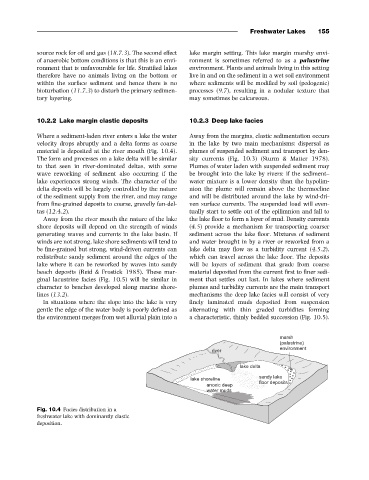
                 Where a sediment-laden river enters a lake the water  Away from the margins, clastic sedimentation occurs
                 velocity drops abruptly and a delta forms as coarse  in the lake by two main mechanisms: dispersal as
                 material is deposited at the river mouth (Fig. 10.4).  plumes of suspended sediment and transport by den-
                 The form and processes on a lake delta will be similar  sity currents (Fig. 10.3) (Sturm & Matter 1978).
                 to that seen in river-dominated deltas, with some  Plumes of water laden with suspended sediment may
                 wave reworking of sediment also occurring if the  be brought into the lake by rivers: if the sediment–
                 lake experiences strong winds. The character of the  water mixture is a lower density than the hypolim-
                 delta deposits will be largely controlled by the nature  nion the plume will remain above the thermocline
                 of the sediment supply from the river, and may range  and will be distributed around the lake by wind-dri-
                 from fine-grained deposits to coarse, gravelly fan-del-  ven surface currents. The suspended load will even-
                 tas (12.4.2).                                tually start to settle out of the epilimnion and fall to
                   Away from the river mouth the nature of the lake  the lake floor to form a layer of mud. Density currents
                 shore deposits will depend on the strength of winds  (4.5) provide a mechanism for transporting coarser
                 generating waves and currents in the lake basin. If  sediment across the lake floor. Mixtures of sediment
                 winds are not strong, lake shore sediments will tend to  and water brought in by a river or reworked from a
                 be fine-grained but strong, wind-driven currents can  lake delta may flow as a turbidity current (4.5.2),
                 redistribute sandy sediment around the edges of the  which can travel across the lake floor. The deposits
                 lake where it can be reworked by waves into sandy  will be layers of sediment that grade from coarse
                 beach deposits (Reid & Frostick 1985). These mar-  material deposited from the current first to finer sedi-
                 ginal lacustrine facies (Fig. 10.5) will be similar in  ment that settles out last. In lakes where sediment
                 character to beaches developed along marine shore-  plumes and turbidity currents are the main transport
                 lines (13.2).                                mechanisms the deep lake facies will consist of very
                   In situations where the slope into the lake is very  finely laminated muds deposited from suspension
                 gentle the edge of the water body is poorly defined as  alternating with thin graded turbidites forming
                 the environment merges from wet alluvial plain into a  a characteristic, thinly bedded succession (Fig. 10.5).


                                                                      !


                 Fig. 10.4 Facies distribution in a
                 freshwater lake with dominantly clastic
                 deposition.

